
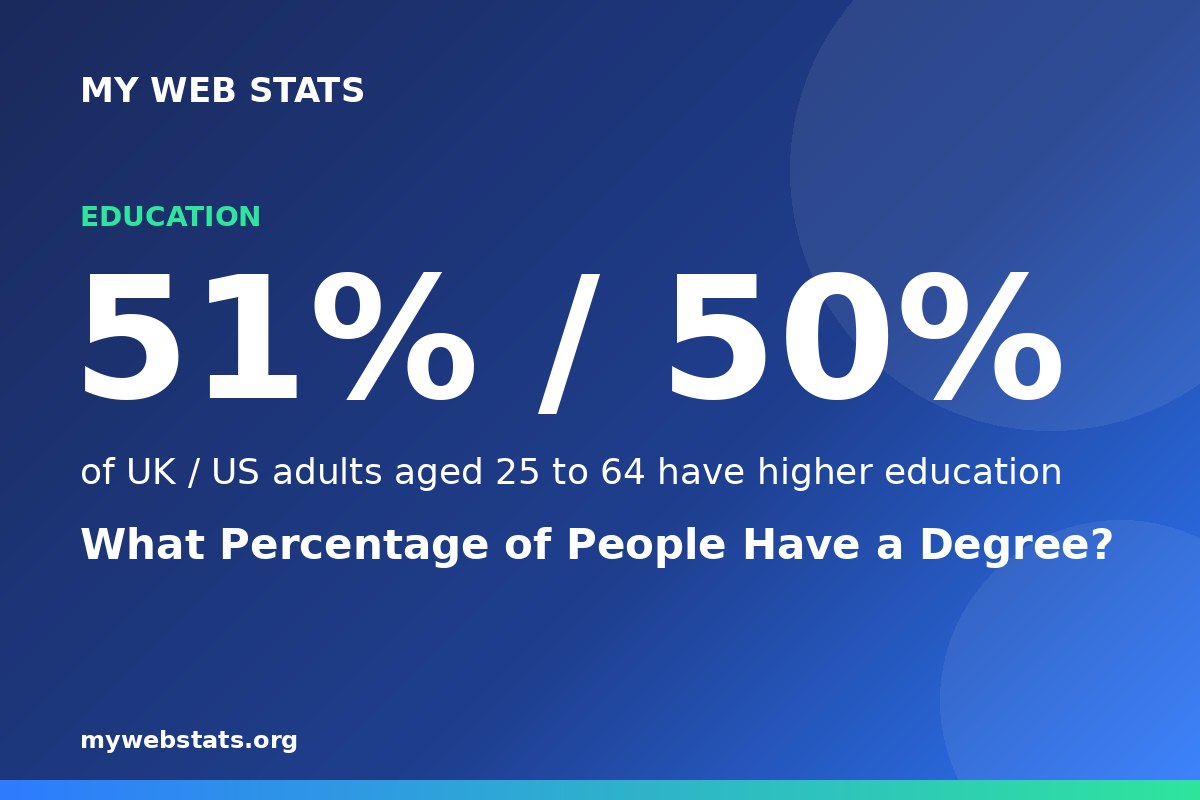
Short answer: about half of adults aged 25 to 64 in the UK (51%) and the US (50%) have completed some form of higher education, on figures from the Organisation for Economic Co-operation and Development (OECD) for 2022. Roughly 4 in 10 hold a bachelor’s degree or higher.
Last updated: November 2026.
Higher education by country
| Country | Any tertiary qualification | Bachelor’s degree or higher |
|---|---|---|
| Canada | 63% | Not comparable |
| Japan | 56% | Not comparable |
| Ireland | 54% | 45% |
| South Korea | 53% | 38% |
| United Kingdom | 51% | 42% |
| Australia | 51% | 40% |
| United States | 50% | 39% |
| France | 42% | 27% |
| Spain | 41% | 28% |
| Germany | 33% | 32% |
| Turkey | 25% | 18% |
| Italy | 20% | 21% |
“Tertiary” is wider than “degree”
The first column counts every qualification above school level. That includes shorter courses such as US associate degrees, UK foundation degrees and Higher National Diplomas, and college diplomas in Canada. This is why Canada tops the table: about a quarter of its adults hold a college diploma instead of a university degree. Germany appears low for the opposite reason. Many skilled Germans qualify through apprenticeships, which are counted as upper secondary education.
The UK and US in more detail
- England and Wales: at the 2021 census, 33.8% of people aged 16 and over had a degree-level qualification or higher. The share is lower than the OECD figure because it includes older and younger people.
- United States: the Census Bureau reports that just under 4 in 10 people aged 25 and over have a bachelor’s degree or more. In 1940 the figure was under 5%.
- Younger adults: in both countries, people aged 25 to 34 are far more likely to hold a degree than those aged 55 to 64.
- Women: in most rich countries, more women than men now graduate. Among young adults the gap is around 10 percentage points.
The world as a whole
Outside the richest countries the share is much lower. The same OECD-based table gives about 19% for China and 13% for India. Taking the world’s adult population together, well under 1 in 5 people has a university degree, though the number is rising quickly as university systems expand across Asia.
Does a degree still pay?
On average, yes. Across OECD countries, graduates earn around 50% more than people whose education ended at school, and are less likely to be unemployed. The average hides a wide spread. Returns vary a great deal by subject and institution, and have to be set against tuition fees and years out of work.
Frequently asked questions
Which country is the most educated?
On the OECD’s tertiary measure, Canada, at 63% of adults aged 25 to 64.
What share of people have a master’s or doctorate?
In the UK and US, roughly 14% to 16% of adults aged 25 to 64 have a master’s degree or higher. About 1% to 2% have a doctorate.
How many young people go to university in the UK?
Around half enter higher education by the age of 30.
Related: College graduation rates · How many students move away for university? · How much of your income should go to student loans?


Leave a Reply