
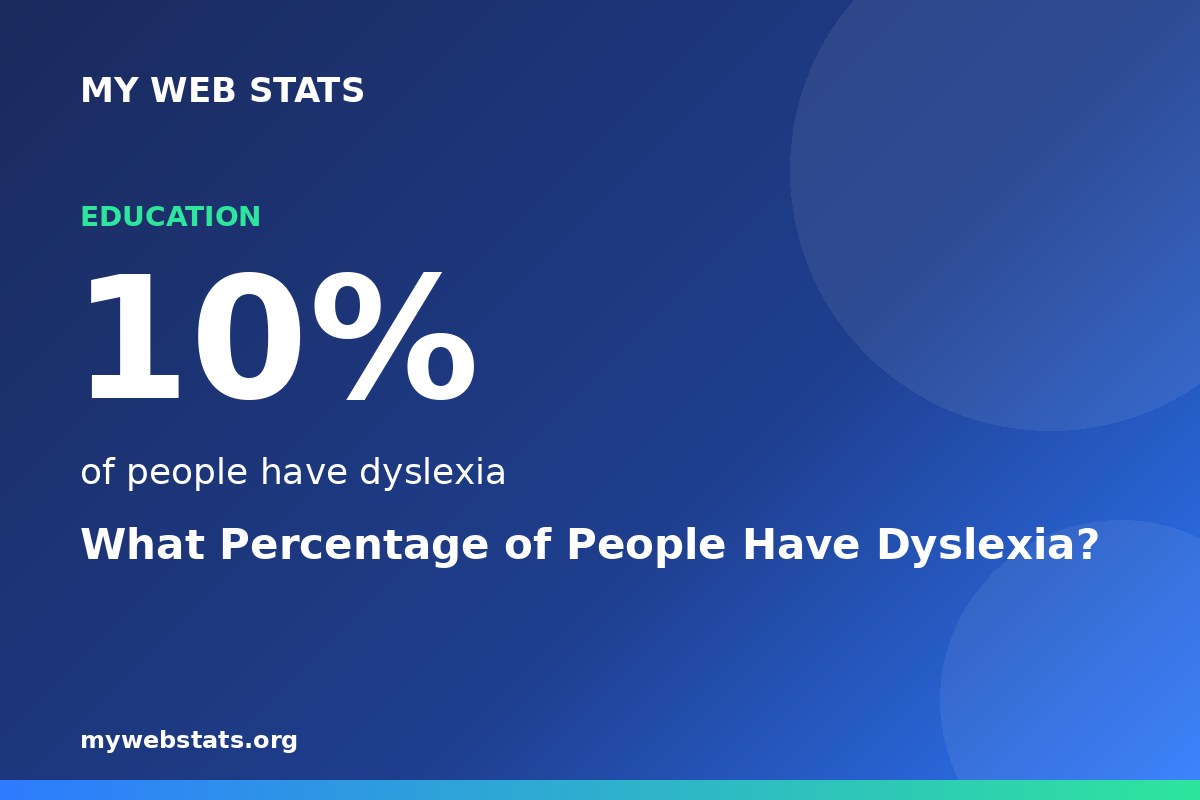
Short answer: about 10% of people are estimated to have dyslexia to some degree. The British Dyslexia Association puts it at 1 in 10 in the UK, with around 4% severely affected. Estimates worldwide range from about 5% to 20% depending on where the line is drawn.
Last updated: November 2026. General information only. A formal diagnosis needs an assessment by a qualified specialist.
Key takeaways
| Measure | Estimate | Source |
|---|---|---|
| People in the UK with dyslexia | About 10%, over 6 million | British Dyslexia Association, NHS |
| Severely affected | About 4% | British Dyslexia Association |
| Range in international research | About 5% to 10% using strict criteria | Research reviews |
| Upper estimates | Up to 15% to 20% | US advocacy and research groups, using broader definitions |
What dyslexia is
Dyslexia is a specific learning difficulty that mainly affects accurate and fluent reading and spelling. The core difficulty is usually with phonological processing: breaking words into their sounds and linking those sounds to letters. It is not related to intelligence, eyesight or effort, and it occurs across the full range of ability.
Why the estimates differ
- No sharp boundary. Reading ability varies continuously. Dyslexia is the lower end of that range, and experts set the threshold in different places.
- Different definitions. Some studies count anyone with persistent reading difficulty; others require a gap between reading and other abilities.
- Language. English spelling is irregular, so difficulties show up more than in languages such as Italian or Finnish, where letters map consistently to sounds.
- Under-identification. Many adults were never assessed at school.
Common signs
| Age | Typical signs |
|---|---|
| Pre-school | Late talking, trouble with rhymes, difficulty learning letters |
| Primary school | Slow, effortful reading; unpredictable spelling; reversing or confusing letters beyond the early years |
| Teenagers and adults | Slow reading and writing, poor spelling, difficulty taking notes or meeting written deadlines |
Causes
Dyslexia runs strongly in families. A child with a dyslexic parent has roughly a 30% to 50% chance of having it. Twin studies put heritability at around 60% to 70%. Brain imaging shows differences in how left-hemisphere language areas are used during reading.
What helps
Structured, systematic teaching of phonics, started early, has the best evidence. Dyslexia does not go away, but most people become competent readers with the right teaching. At school and work, extra time, text-to-speech software and spell-checkers make a real difference. In the UK, dyslexia can count as a disability under the Equality Act 2010, which requires reasonable adjustments.
Frequently asked questions
Is dyslexia more common in boys?
Boys are identified more often, at roughly two to one. Part of that gap reflects who gets referred for assessment.
Does dyslexia mean seeing letters backwards?
No. That is a common myth. It is a difficulty with the sounds of language, not with vision.
Are dyslexia and ADHD linked?
They often occur together. Studies suggest a quarter to 40% of children with one also meet criteria for the other.
Related: ADHD statistics · Speech and language difficulties in children · Average reading speed
Leave a Reply