
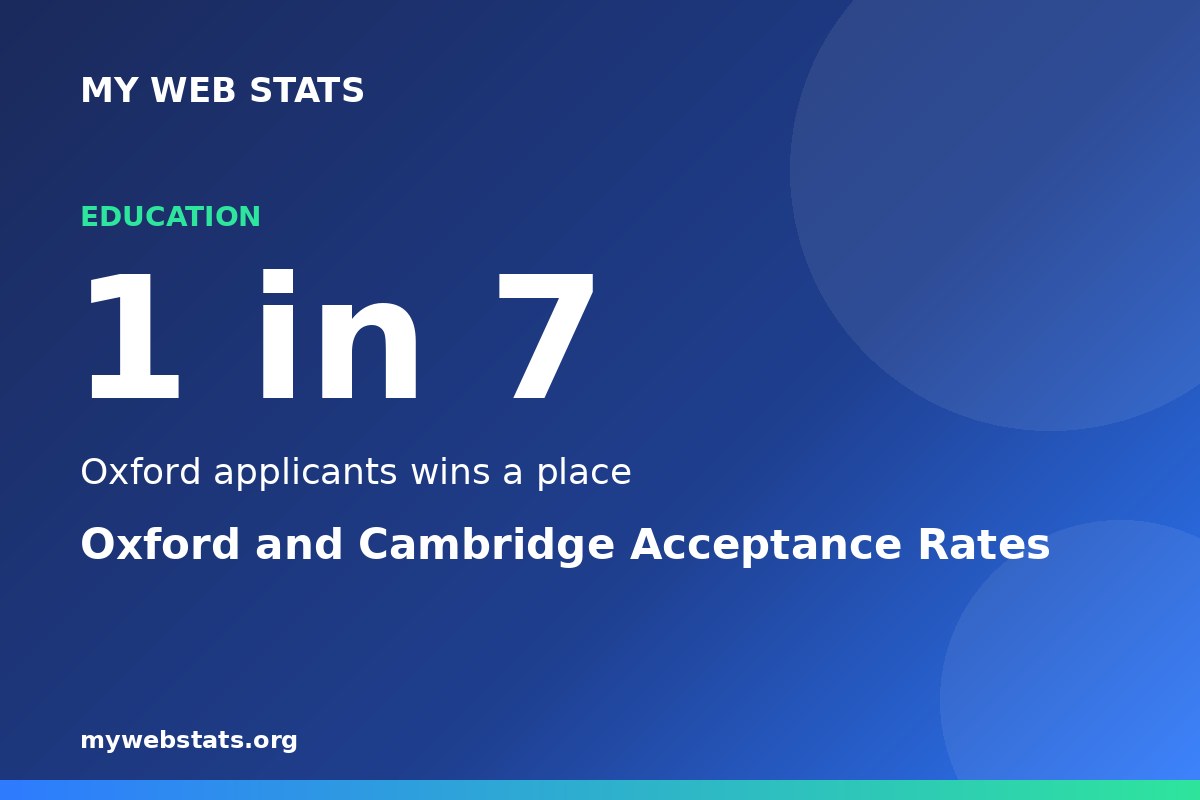
Short answer: roughly 1 in 7 applicants to Oxford wins a place, and at Cambridge it is about 1 in 6. Oxford admitted 3,302 undergraduates in 2025. Cambridge says it receives about six applications for every place, averaged across all subjects.
Last updated: November 2026. Rates vary a great deal by course.
The headline numbers
| Measure | Oxford | Cambridge |
|---|---|---|
| Undergraduates admitted, 2025 | 3,302 | About 3,500 |
| Applications per year | About 23,000 | About 22,000 |
| Applications per place | About 7 | About 6 |
| Approximate chance of a place | 14% | 16% |
Both universities make more offers than they have places, because some applicants miss their grades or choose to go elsewhere. So the offer rate is a little higher than the acceptance rate. At Cambridge roughly 1 in 5 applicants receives an offer.
Who gets in to Oxford
| Measure | 2021 | 2025 |
|---|---|---|
| UK students from state schools | 68.2% | 66.5% |
| UK students who were eligible for free school meals | 5.3% | 6.6% |
| UK students who declared a disability | 11.6% | 19.5% |
| UK students who are women | 55.2% | 50.6% |
About 93% of UK pupils attend state schools, so they remain under-represented at both universities, though the share is far higher than a generation ago. In the early 2000s it was close to half.
It depends heavily on the course
- Most competitive: Computer Science, Economics and Management, Medicine and Law attract the most applicants per place. Success rates for some are around 5% to 10%.
- Least competitive: Classics, Modern Languages, Music and Theology have far fewer applicants per place, with success rates of 30% or more.
- Lower competition does not mean lower standards. The grades required are similar across courses.
How applying differs from other universities
- The deadline is mid-October, about three months earlier than for most UK courses.
- You cannot apply to both Oxford and Cambridge in the same year for a first degree.
- Most courses require an admissions test, and shortlisted candidates are interviewed in December.
- You apply to a college, or make an open application and are assigned one.
- Typical offers are A*A*A to AAA at A level, or the equivalent.
How that compares
Oxford and Cambridge are far less selective on paper than the top American universities, where acceptance rates are 4% to 6%. The comparison is misleading, though. UK applicants can choose only five courses in total, and must already be predicted top grades, so far fewer speculative applications are made.
Frequently asked questions
Does the choice of college affect your chances?
Not much. Both universities move strong candidates between colleges so that the best applicants get places whichever college they chose.
Is it harder for international students?
Generally yes. Success rates for overseas applicants are lower, and Medicine has a strict cap on international places.
How many students are there in total?
Each university has roughly 12,000 to 13,000 undergraduates and a similar number of postgraduates.
Related: Ivy League acceptance rates · What percentage of people have a degree? · How many students move away for university?




Leave a Reply