
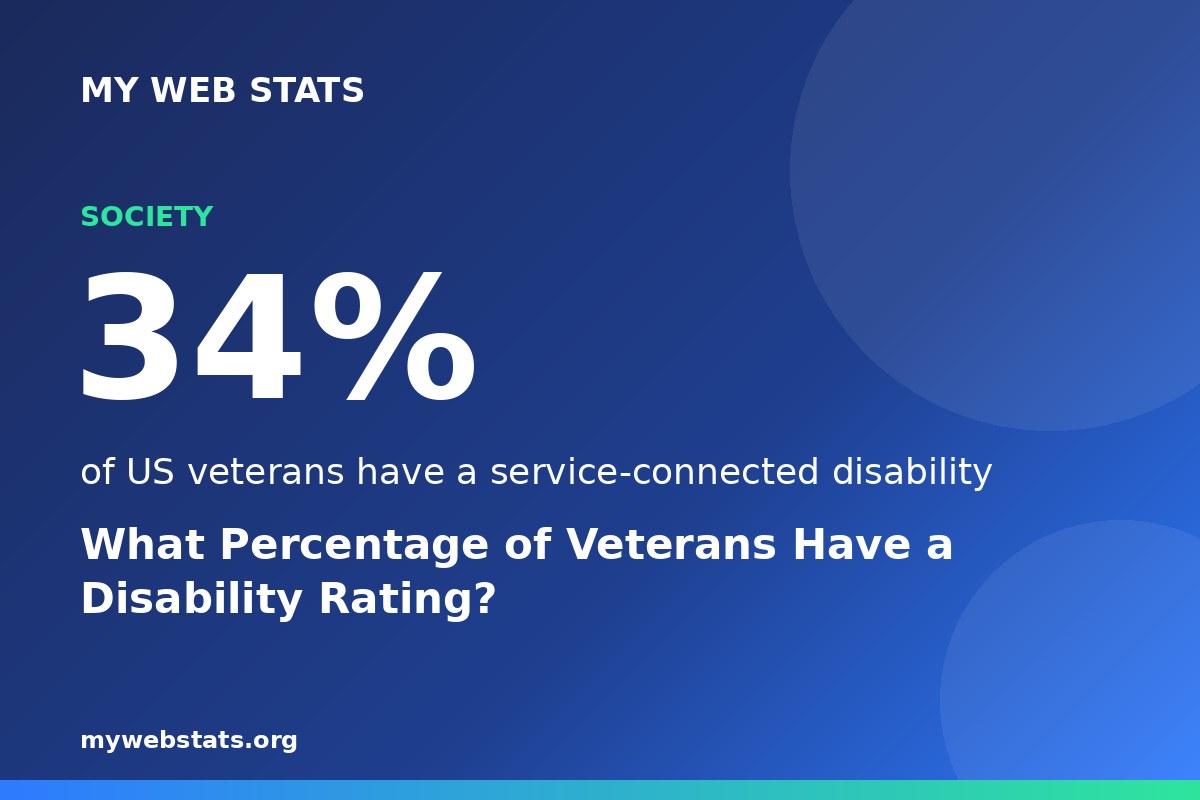
Short answer: 34% of US veterans, about 5.8 million of 17.3 million, have a service-connected disability, according to the Bureau of Labor Statistics. Among veterans who served after September 2001, the share is 50%.
Last updated: November 2026.
Key takeaways
| Measure (2025) | Figure |
|---|---|
| Total US veterans | 17.3 million |
| Veterans with a service-connected disability | 5.8 million (34%) |
| Gulf War-era II veterans with a service-connected disability | 2.8 million (50%) |
| Of those with a disability, share rated 60% or higher | 59% |
| Same, among Gulf War-era II veterans | 70% |
| Unemployment rate, all veterans | 3.5% |
What “service-connected disability” means
It is an injury or illness that was caused or made worse by military service, as decided by the Department of Veterans Affairs (VA). It is not the same as being unable to work. Many veterans with a rating are employed full time.
The VA gives each condition a rating from 0% to 100% in steps of 10, reflecting how much it is judged to reduce overall health and earning capacity. Ratings for several conditions are combined using a set formula rather than simply added. Monthly tax-free compensation starts at a rating of 10% and rises with each step.
Why the share has risen
In the early 2000s only around 1 in 10 veterans had a service-connected disability. Several things explain the rise to 1 in 3.
- Survival: better battlefield medicine means more service members survive serious injuries.
- Recognition: conditions such as post-traumatic stress, traumatic brain injury, hearing loss and tinnitus are diagnosed and accepted far more readily.
- Law changes: the 2022 PACT Act extended eligibility to veterans exposed to burn pits and other toxic substances, and added many “presumptive” conditions.
- Awareness: service members now receive help filing claims before they leave.
- A changing population: older generations with low claim rates are passing away, while post-9/11 veterans claim at much higher rates.
Most common conditions
VA benefits reports consistently show tinnitus as the single most common service-connected condition, followed by limited movement of the knee, hearing loss, back and neck strain, scars and post-traumatic stress disorder.
United Kingdom
The UK has no direct equivalent of the rating system. The 2021 census counted about 1.85 million veterans in England and Wales, and found that around a third reported a disability of any kind. That is higher than among non-veterans mainly because veterans are older on average; after adjusting for age the difference is small. Compensation for service-related injury is paid through the War Pension Scheme and the Armed Forces Compensation Scheme.
Frequently asked questions
How many veterans are rated 100% disabled?
The BLS does not publish that exact figure, but 59% of veterans with a service-connected disability are rated 60% or higher. VA data indicate that well over a million veterans hold a 100% rating.
Can veterans with a disability rating work?
Yes. Compensation is not means-tested, and most rated veterans of working age are in work.
How many veterans are there in the US?
About 17.3 million, roughly 6% to 7% of the adult population. The number is falling as the Second World War, Korea and Vietnam generations age.
Related: How much of the US budget goes on the military? · Foreign-born soldiers in the US Civil War · How many people live in the US?



Leave a Reply