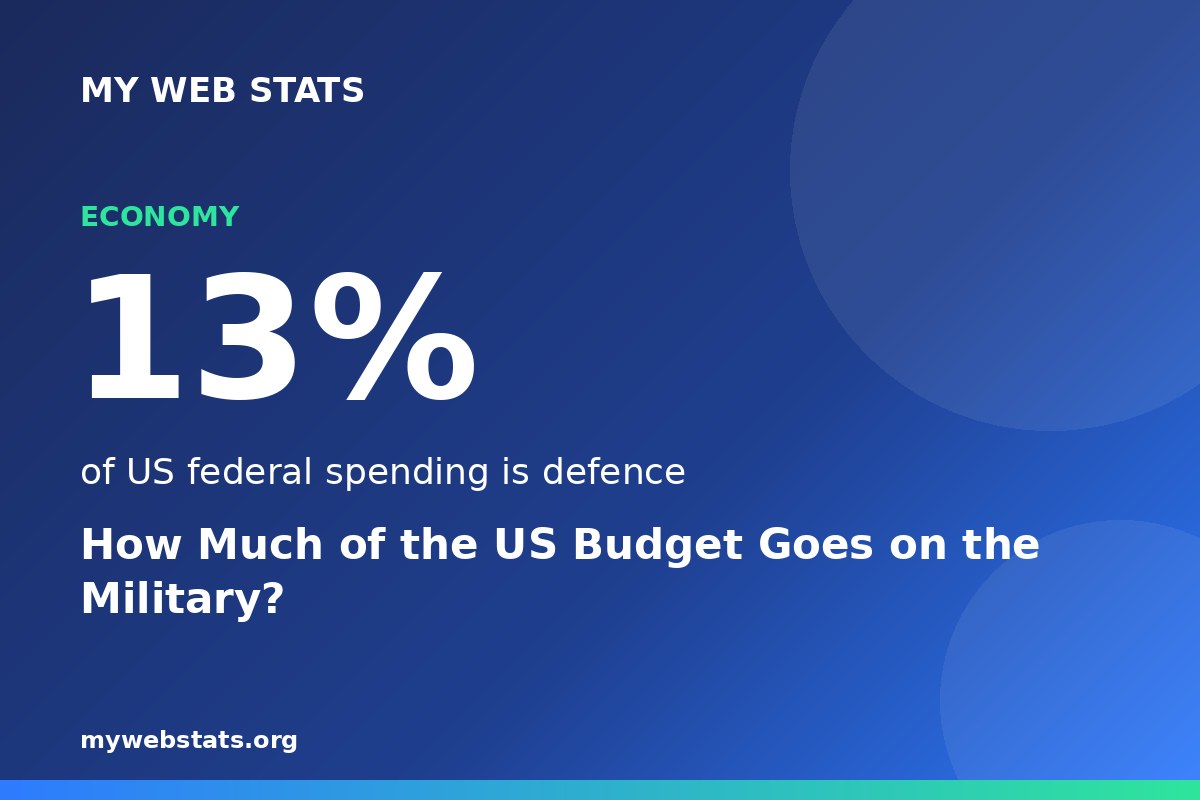
Short answer: about 13% of total US federal spending goes on national defence. It is nearly half of the “discretionary” budget that Congress votes on each year, and about 3.4% of the country’s GDP.
Last updated: November 2026.
Key takeaways
| Measure | Approximate figure |
|---|---|
| Share of total federal spending | About 13% |
| Share of discretionary spending | Close to half |
| Share of GDP | About 3.4% |
| Share of world military spending | About 37% |
| Annual amount | Around $850 billion to $1 trillion, depending on what is counted |
Why you see both “13%” and “half”
Both are correct. They use different totals.
- Total spending is close to $7 trillion a year. Most of it is “mandatory”: Social Security, Medicare, Medicaid and other programmes that pay out automatically under existing law, plus interest on the national debt.
- Discretionary spending is the part set through annual appropriations, about $1.8 trillion. Defence is a little under half of that.
Where federal money goes
| Category | Share of federal spending (approx.) |
|---|---|
| Social Security | 21% to 22% |
| Medicare, Medicaid and other health | About 25% to 27% |
| Net interest on the debt | About 13% to 14% |
| National defence | About 13% |
| Income security, veterans, education, transport and everything else | About 25% |
What the defence budget pays for
- Operations and maintenance: the largest slice, around 40%. Training, fuel, repairs and running bases.
- Personnel: pay and benefits for about 1.3 million active-duty troops, roughly a fifth to a quarter.
- Procurement: buying ships, aircraft and equipment, about a fifth.
- Research and development: around 15% to 17%.
Veterans’ benefits and healthcare are budgeted separately and are not included in the 13%. They add more than $300 billion a year.
How the US compares
The Stockholm International Peace Research Institute (SIPRI) put US military spending at $997 billion in 2024, 37% of the world total and more than the next nine countries combined. As a share of the economy, though, the US figure of 3.4% of GDP is far below Cold War levels: it was about 9% in the late 1960s and 6% in the mid-1980s. The UK spends about 2.3% of GDP.
Frequently asked questions
Is defence the biggest item in the US budget?
No. Social Security and health programmes are each larger, and interest on the debt is now about the same size.
How much is that per person?
Roughly $2,500 to $2,900 a year for every US resident.
Has the share been rising?
In dollars, yes. As a share of the budget and of GDP it has drifted down over decades, because health, pensions and interest have grown faster.
Related: What percentage of income is typically taxed? · Biggest oil producing countries · How many people live in the US?