
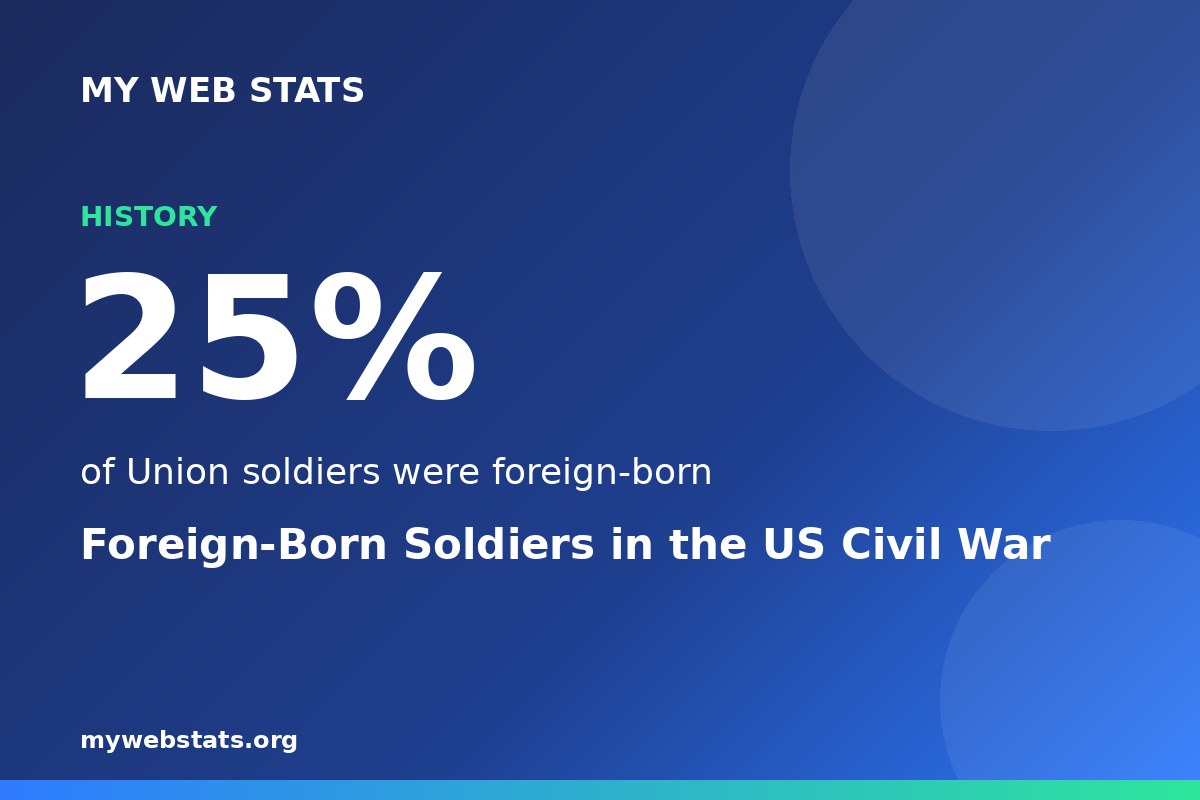
Short answer: about one in four Union soldiers was born outside the United States, roughly 500,000 to 550,000 men out of some 2.2 million. Germans and Irish made up the two largest groups. The Confederate army had far fewer immigrants.
Last updated: November 2026.
Key takeaways
- Around 25% of the Union army was foreign-born.
- Counting sons of immigrants as well, historians estimate that more than 40% of Union soldiers were immigrants or had at least one immigrant parent.
- Immigrants were about 13% of the US population in the 1860 census, and most lived in the North.
- All figures are estimates. Enlistment records did not always note birthplace, and many men served more than once.
Union soldiers by country of birth
| Country or region of birth | Estimated Union soldiers |
|---|---|
| German states | About 200,000 or more |
| Ireland | About 150,000 |
| Britain (England, Scotland, Wales) | About 50,000 to 60,000 |
| Canada (British North America) | About 50,000 |
| Other countries (Scandinavia, France, Italy, Poland, Hungary and more) | Tens of thousands |
| Total foreign-born | Roughly 500,000 to 550,000 |
Why so many immigrants fought for the Union
The simplest reason is geography. The 1860 census counted about 4.1 million foreign-born residents, and the great majority had settled in northern cities and the Midwest, where the jobs and farmland were. Fewer than one in ten lived in the states that later formed the Confederacy.
- Pay and bounties: a private’s wage of $13 a month, plus enlistment bounties, was attractive to recent arrivals.
- Politics: many German “Forty-Eighters” had fled failed revolutions in Europe and strongly opposed slavery.
- Belonging: service was a way to prove loyalty to a new country at a time of strong anti-immigrant feeling.
- The draft: from 1863, immigrants who had declared their intention to become citizens could be conscripted.
Ethnic regiments
Most immigrants served in ordinary mixed units, but some regiments were raised from a single community. The Irish Brigade, built around New York’s 69th Infantry, fought at Antietam, Fredericksburg and Gettysburg. The XI Corps had so many German speakers that orders were sometimes given in German. The 15th Wisconsin was largely Norwegian, and the 39th New York, the “Garibaldi Guard”, drew men from more than a dozen nations.
What about the Confederacy?
The South had a much smaller immigrant population, concentrated in port cities such as New Orleans, Charleston and Mobile. Estimates of foreign-born Confederate soldiers run to tens of thousands, a low single-digit to roughly 5% share of the army. Irish and German units existed there too, including Louisiana regiments recruited from the New Orleans docks.
Frequently asked questions
Did British people fight in the American Civil War?
Yes. Tens of thousands of British-born men served, mostly for the Union and mostly as existing residents of the US. Britain itself stayed officially neutral.
How many soldiers fought in total?
About 2.2 million served the Union and somewhere between 750,000 and 1 million the Confederacy. Modern estimates put total deaths at 620,000 to 750,000.
Were immigrants over-represented in the Union army?
Compared with the whole US population, yes: about 25% of soldiers against 13% of residents. Compared with military-age men in the northern states alone, the shares were much closer.
Related: How many people live in the US? · What percentage of Americans have a passport? · What percentage of Americans speak Spanish?
Leave a Reply