
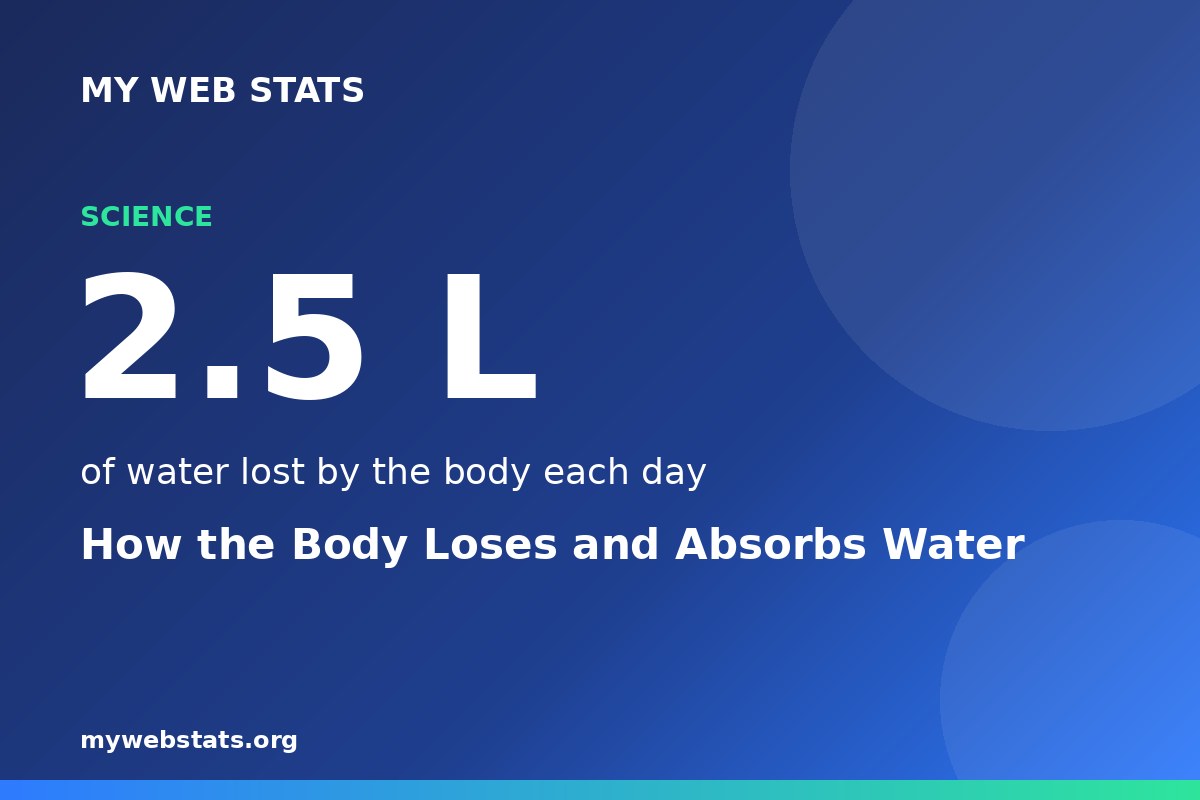
Short answer: a resting adult loses about 2.5 litres of water a day. Around 60% leaves as urine, about 20% through the skin, roughly 12% to 15% in breath and about 4% in stool. In the gut, the small intestine absorbs 80% to 90% of the water that passes through it.
Last updated: November 2026. General information only, not medical advice.
Daily water loss by route
| Route | Typical volume a day | Share of total |
|---|---|---|
| Urine (kidneys) | About 1,500 ml | About 60% |
| Skin, without visible sweating | About 350 to 450 ml | About 16% |
| Breath (lungs and airways) | About 300 to 400 ml | About 12% to 15% |
| Sweat | About 100 ml at rest | About 4% |
| Stool | About 100 to 200 ml | About 4% to 6% |
| Total | About 2,500 ml | 100% |
Water lost through breathing
Air is warmed and moistened on the way into the lungs, and leaves the body almost saturated with water vapour. That is why breath fogs on a cold day. At rest this costs about 300 to 400 ml a day. Hard exercise, cold dry air and high altitude all raise the figure, because you breathe faster and the incoming air holds less moisture.
Together with evaporation through the skin, this is called insensible water loss: you do not notice it and cannot control it. It adds up to about 700 to 900 ml a day.
Sweat changes everything
Sweat is the most variable route. At rest in a cool room it is close to nothing. During vigorous exercise in the heat it can reach 1 to 2 litres an hour, at which point it becomes by far the largest loss. The kidneys respond by cutting urine output to as little as 500 ml a day.
How the gut absorbs water
Far more water passes through the gut than you drink. About 2 litres comes from food and drink, and another 7 litres or so from the body’s own secretions: saliva, stomach acid, bile, pancreatic juice and intestinal fluid. Nearly all of it is reabsorbed.
| Part of the gut | Water absorbed a day | Share of the 9 litres entering |
|---|---|---|
| Small intestine | About 7 to 8 litres | About 80% to 90% |
| Large intestine (colon) | About 1 to 1.5 litres | About 10% to 15% |
| Lost in stool | About 0.1 to 0.2 litres | About 1% to 2% |
Water is not pumped across the gut wall directly. The intestine absorbs sodium, glucose and other solutes, and water follows by osmosis. This is why oral rehydration solutions contain both salt and sugar: the pairing speeds up water uptake.
Where water comes in
- Drinks: about 1.5 litres a day.
- Food: about 0.7 litres. Fruit and vegetables are mostly water.
- Metabolism: about 0.3 litres, made when the body burns carbohydrate, fat and protein.
Frequently asked questions
How much water do you lose while sleeping?
Roughly 200 to 400 ml over eight hours through breath and skin, plus whatever the kidneys send to the bladder. It explains part of the weight difference between night and morning.
Does the stomach absorb water?
Very little. Water passes quickly through the stomach and is absorbed mainly in the small intestine.
How much should I drink?
The NHS suggests 6 to 8 cups or glasses of fluid a day for most adults, and more in hot weather or when active.
Related: What percentage of the human body is water? · What is blood made of? · How much water vapour is in the air?




Leave a Reply