
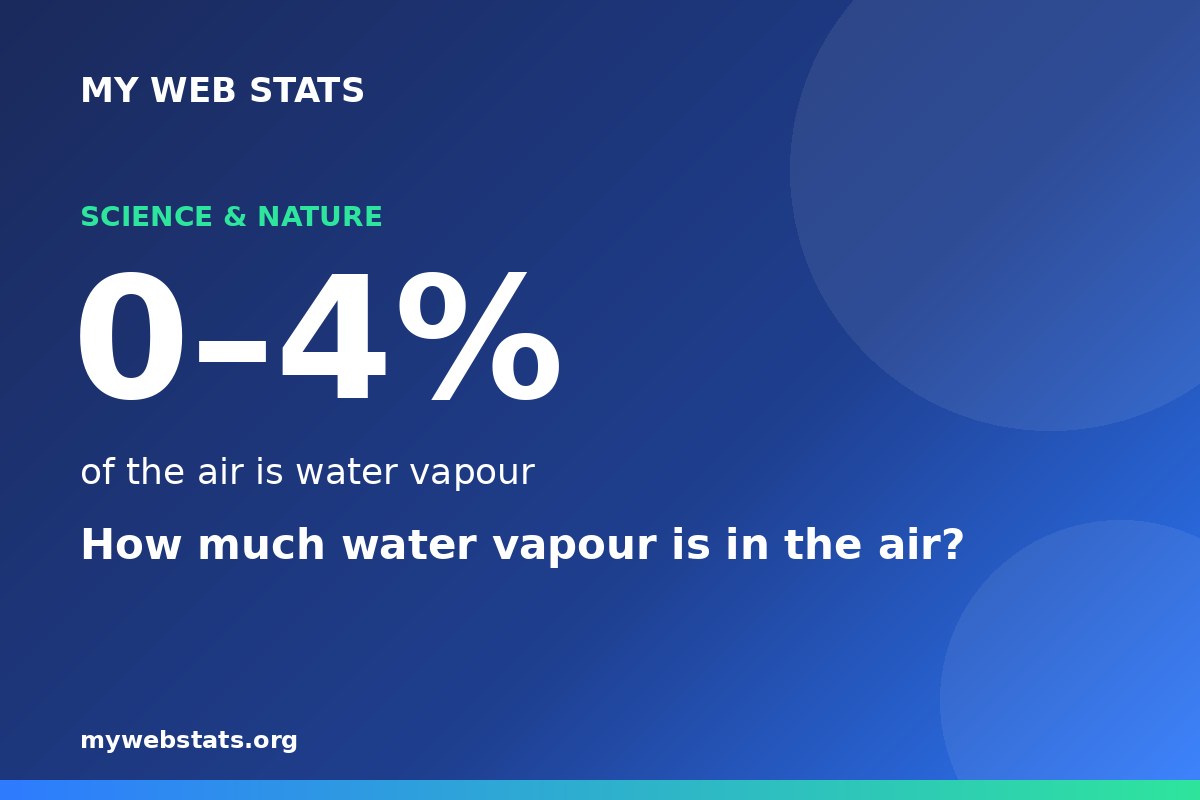
Short answer: water vapour makes up between almost 0% and about 4% of the air by volume. Cold, dry air over deserts and the poles holds close to none. Hot, humid tropical air holds the most.
Last updated: November 2026.
Key takeaways
- The atmosphere holds about 12,900 cubic kilometres of water at any moment. That is only about 0.001% of all the water on Earth.
- If it all fell as rain at once, it would cover the globe to a depth of about 2.5 cm (1 inch).
- Warm air can hold more water vapour: about 7% more for every 1°C of warming.
- Water vapour is the most abundant greenhouse gas in the atmosphere.
What dry air is made of
| Gas | Share of dry air by volume |
|---|---|
| Nitrogen | 78% |
| Oxygen | 21% |
| Argon | 0.93% |
| Carbon dioxide | About 0.04% |
Relative vs absolute humidity
- Absolute humidity is the actual amount of water vapour in the air, in grams per cubic metre.
- Relative humidity is the amount of vapour as a percentage of the most the air could hold at that temperature. This is the figure in weather forecasts.
- Dew point is the temperature at which the air becomes saturated and water starts to condense.
This is why 100% relative humidity does not mean the air is 100% water. On a 30°C day at 100% relative humidity, water vapour is still only about 4% of the air.
How much water can air hold?
| Air temperature | Maximum water vapour (approx.) |
|---|---|
| 0°C | 5 g per cubic metre |
| 10°C | 9 g per cubic metre |
| 20°C | 17 g per cubic metre |
| 30°C | 30 g per cubic metre |
How long does water stay in the air?
Not long. A water molecule spends roughly nine or ten days in the atmosphere on average before it falls as rain or snow.
Frequently asked questions
What is a comfortable humidity indoors?
Most guidance suggests a relative humidity of about 40% to 60%. Above that, damp and mould become more likely.
Is humid air heavier than dry air?
No, it is lighter. A water molecule weighs less than the nitrogen and oxygen molecules it replaces.
Related: how much does a cloud weigh · how much of Earth’s water is fresh · oxygen in the atmosphere
Leave a Reply