
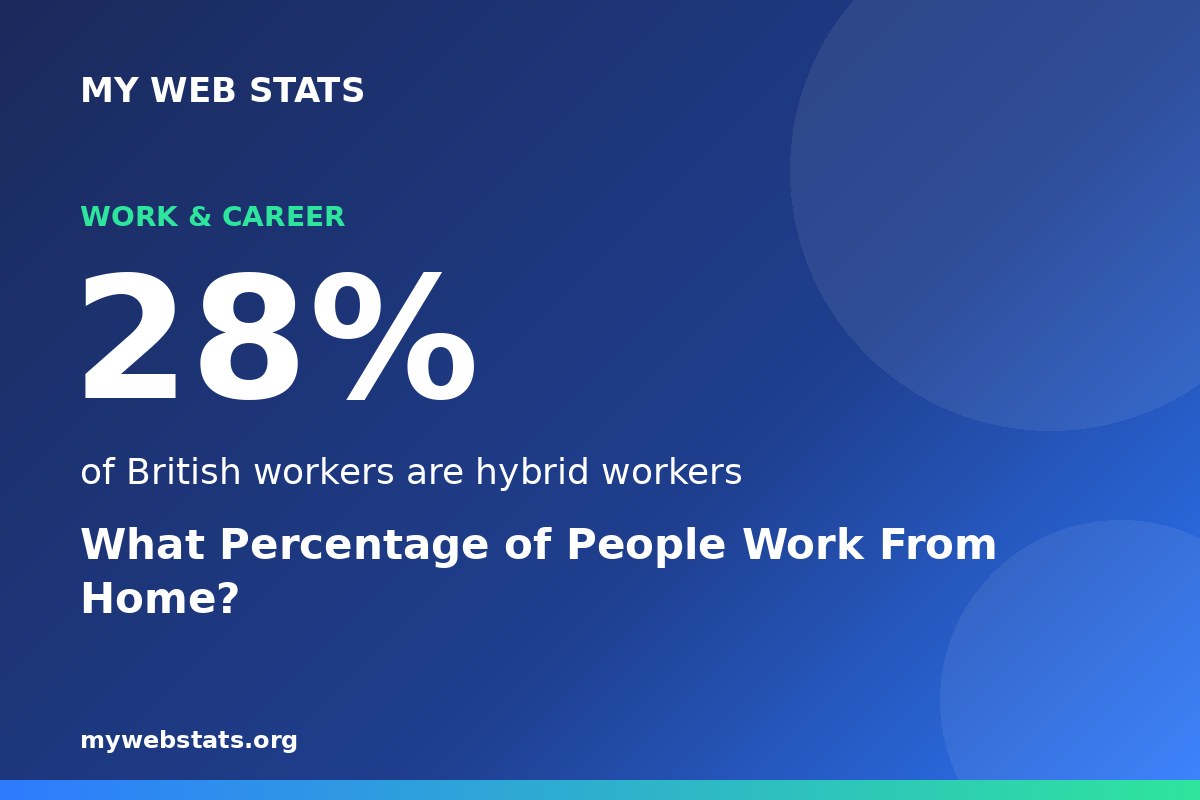
Short answer: in Great Britain, 28% of working adults were hybrid workers in autumn 2024, according to the Office for National Statistics (ONS). That means they split their week between home and a workplace. A further share, roughly 1 in 8, worked only from home. Most people still travel to work every day.
Last updated: November 2026.
Who works in a hybrid way
| Group | Share who were hybrid workers |
|---|---|
| All working adults, autumn 2024 | 28% |
| Workers aged 30 and over | 29% |
| Workers aged 16 to 29 | 19% |
| Working parents | 35% |
| Fathers in work | 41% |
| Mothers in work | 30% |
| Workers who are not parents | 24% |
| Workers with a degree or equivalent | 42% |
| Workers with no qualifications | 4% |
| Managers, directors and senior officials | 45% |
| Caring, leisure and service jobs | 3% |
| Elementary occupations | 3% |
The pattern is clear. Hybrid working is mainly available to people in well-paid desk jobs. A graduate is about ten times as likely to work this way as someone with no qualifications. Jobs that involve caring for people, serving customers or handling goods can rarely be done from a kitchen table.
What people do with the time
ONS time-use data from March 2024 found that people working from home saved an average of 56 minutes a day by not commuting. Compared with those who travelled to work, they spent 24 more minutes on sleep and rest and 15 more minutes on exercise, sport and wellbeing.
Before and after the pandemic
- In 2019, only about 1 in 20 UK workers worked mainly from home.
- In April 2020, during the first lockdown, nearly half of those in work did at least some of it at home.
- Since 2021, working only from home has fallen, while hybrid working has grown and settled at around a quarter of the workforce. The ONS calls it the “new normal” for that group.
The United States
The US Census Bureau’s American Community Survey found that 13.8% of workers mainly worked from home in 2023. That is down from a peak of 17.9% in 2021, but more than double the 5.7% recorded in 2019. Separate monthly figures from the Bureau of Labor Statistics show a little over 1 in 5 workers doing some or all of their work remotely.
Frequently asked questions
Do I have a right to work from home?
Not automatically. In Great Britain, employees can ask for flexible working from their first day in a job, and the employer must consider the request reasonably.
Which days do hybrid workers go in?
Office attendance is highest from Tuesday to Thursday and lowest on Friday.
Is home working falling?
Fully remote work has declined since 2021. Hybrid work has held steady, despite some large employers ordering staff back full time.
Related: Average working hours by country · Annual leave by country · What percentage of people have a degree?




Leave a Reply