
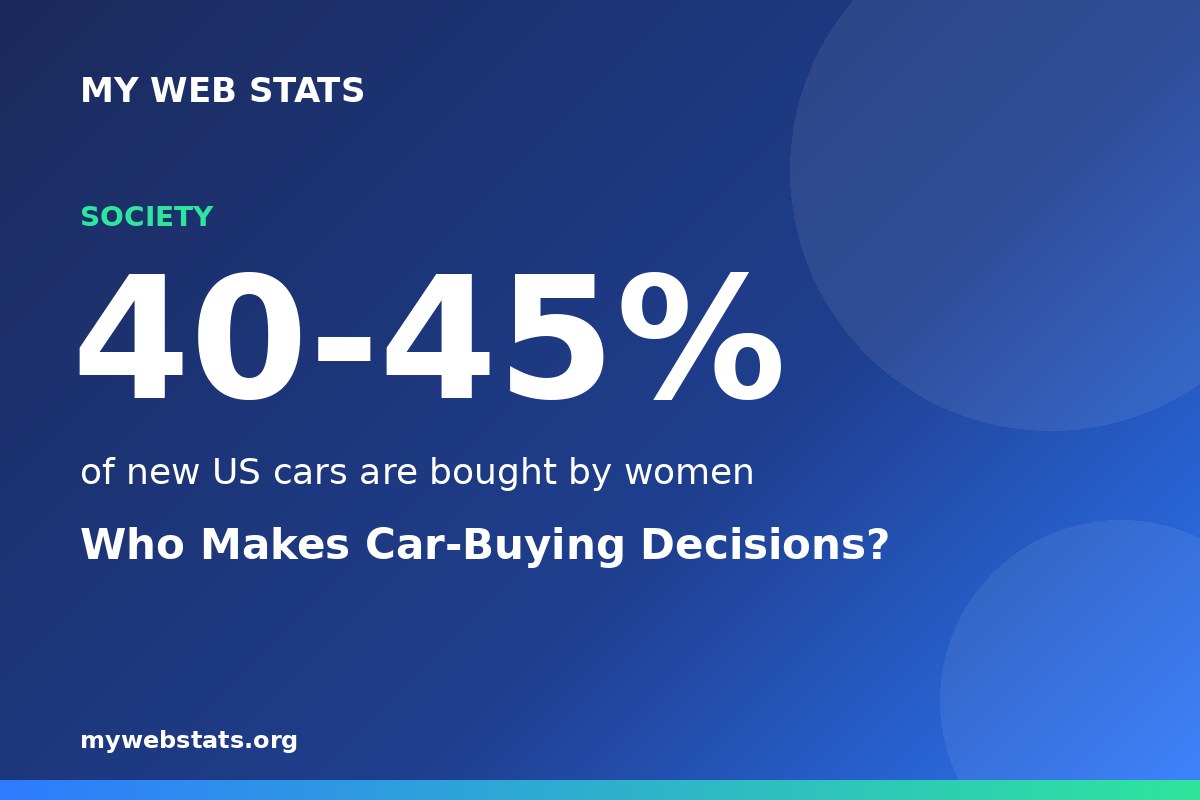
Short answer: women are the registered buyer of roughly 40% to 45% of new cars sold in the United States. The widely repeated line that “women make or influence 85% of car-buying decisions” has been quoted for decades, but no original study behind it can be found. It is best treated as a marketing slogan.
Last updated: November 2026. Figures are approximate and come from industry data.
What can be measured
| Measure | Women’s share (approx.) |
|---|---|
| New vehicle registrations in the US | 40% to 45% |
| US licensed drivers | Just over 50% |
| UK full driving licence holders | About 46% to 47% |
| Car dealership sales staff in the US | Around a fifth or less |
Where “85%” comes from
The figure appears in countless articles, usually phrased as women “influencing” 80% or 85% of purchases. It tends to be credited to another article, which credits another. Journalists and researchers who have tried to trace it have not found a survey with a method and a sample behind it. A similar claim that women control 80% of all consumer spending has the same problem.
“Influence” is also elastic. In a household that shares a car, almost any purchase could be said to be influenced by both partners. That makes the number impossible to check and easy to inflate.
How men and women buy differently
Buyer surveys by firms such as Cox Automotive, J.D. Power and S&P Global Mobility do show consistent patterns.
- Vehicle type: women are the majority of buyers of small and compact SUVs and of several mainstream brands. Men are the large majority of buyers of pickup trucks, sports cars and luxury performance models.
- Priorities: women more often rank safety, reliability and running costs first. Men more often cite performance, technology and styling.
- Research: women tend to spend longer researching and are more likely to be undecided on brand when they start.
- The dealership: women report lower satisfaction with the showroom experience and are more likely to say they felt talked down to.
- Electric cars: early buyers have skewed heavily male, at around two thirds or more, though the gap is narrowing.
Joint decisions are the norm
For couples, a car is usually the second-largest purchase after a home, and surveys find most describe the decision as shared. Registration data records only one name, so it understates joint decisions in both directions. The safest summary is that women are directly responsible for a little under half of new car purchases and have a say in many of the rest.
Frequently asked questions
Do women pay more for cars?
Some US studies of negotiated prices have found women quoted or paying slightly more on average. Fixed-price and online buying reduce the difference.
Are there more male or female drivers?
In the US, women have slightly outnumbered men among licensed drivers since the mid-2000s. In Great Britain men still hold a few more licences, but the gap has closed steadily.
Who drives more miles?
Men, by a wide margin: roughly 16,500 miles a year on average in the US against about 10,000 for women, according to federal figures.
Related: How much does a car weigh? · Average price of petrol and gas: UK vs US · What percentage of truck drivers are women?






Leave a Reply