
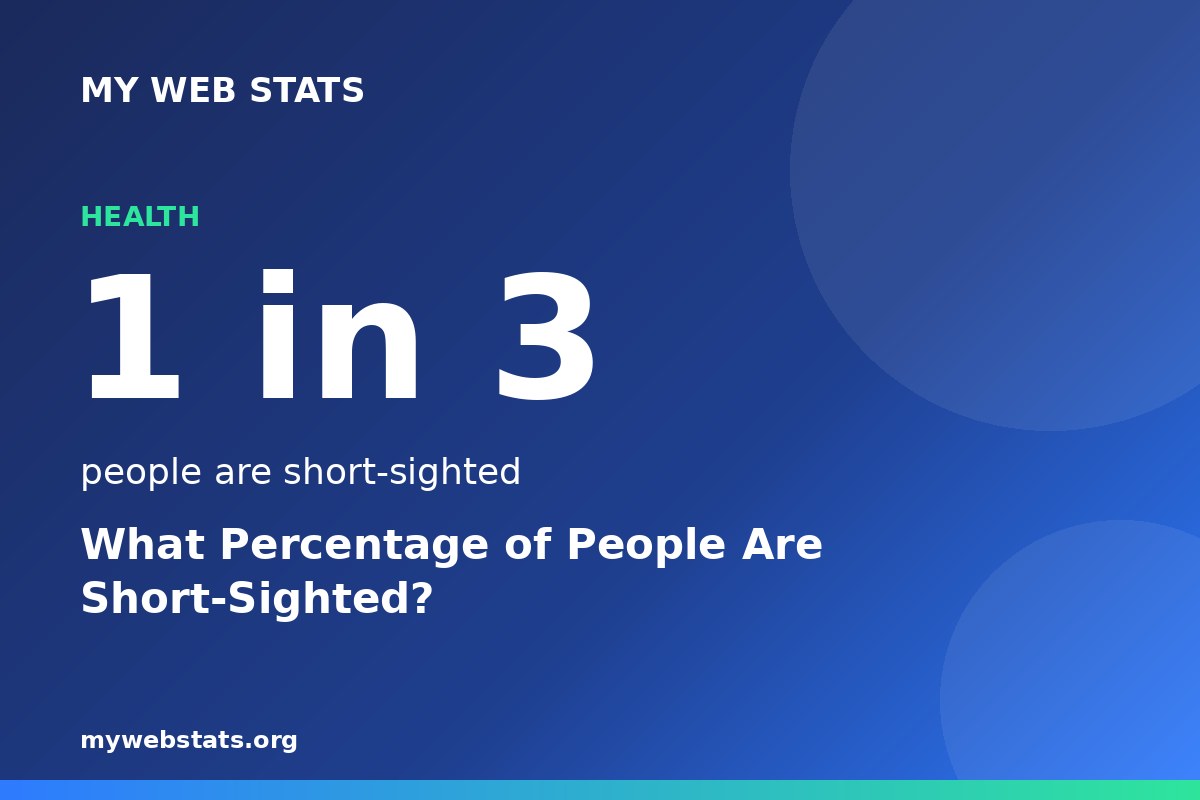
Short answer: roughly a third of people worldwide are short-sighted. A widely cited study projects that this will rise to about half the world’s population by 2050. In the UK the figure is around 1 in 3 adults.
Last updated: November 2026. General information only, not medical advice. See an optometrist for an eye test.
Short-sightedness at a glance
| Measure | Estimate |
|---|---|
| World population short-sighted, 2000 | About 23% |
| World population short-sighted, 2020 | About 34% |
| Projected for 2050 | About 50%, nearly 5 billion people |
| UK adults | About 1 in 3 |
| US adults | About 40% |
| Young adults in urban East Asia | 80% to 90% |
What short-sightedness is
Short-sightedness, or myopia, means distant objects look blurred while close ones are clear. It usually happens because the eyeball has grown slightly too long, so light focuses in front of the retina instead of on it. It typically starts in childhood and stabilises in early adulthood. Americans call it near-sightedness.
Why it is rising so fast
Genes play a part: children with two short-sighted parents are several times more likely to be short-sighted. But genes cannot explain a doubling in two generations. The evidence points to how children spend their time.
- Too little time outdoors. This is the best-supported factor. Bright daylight appears to slow the lengthening of the eye. Trials in Taiwan and China found that adding outdoor time at school reduced new cases.
- More close work. Long hours of reading, studying and screen use at short distances are associated with higher rates.
- More years in education. Rates rise with each additional year of schooling.
This explains the regional pattern. In cities in South Korea, Taiwan, Singapore and China, where schooling is intensive and children spend little time outside, 80% to 90% of school leavers are short-sighted. In the 1950s the figure was 10% to 20%.
In the UK
Research at Ulster University found that short-sightedness among UK children has more than doubled over the past 50 years, and that around 1 in 5 teenagers is now affected. Children are also developing it at younger ages, which matters because earlier onset usually means a stronger prescription in adulthood.
Does it matter beyond needing glasses?
For most people it is fully corrected with glasses, contact lenses or laser surgery. High myopia, generally a prescription stronger than about −6, raises the lifetime risk of retinal detachment, glaucoma and damage to the central retina. The same study projected that close to 1 in 10 people worldwide will have high myopia by 2050.
Frequently asked questions
How much outdoor time helps?
Studies suggest around two hours a day outdoors lowers a child’s risk of becoming short-sighted.
Do screens cause short-sightedness?
Screens are one form of close work. The stronger link is with time spent indoors focusing at short distances, whatever the activity.
Can it be slowed in children?
Yes. Specially designed spectacle and contact lenses and low-dose atropine eye drops have been shown to slow progression. An optometrist can advise.
Related: Blue light glasses: what percentage should they block? · What percentage of people are colour blind? · What percentage of people have blue eyes?
Leave a Reply