
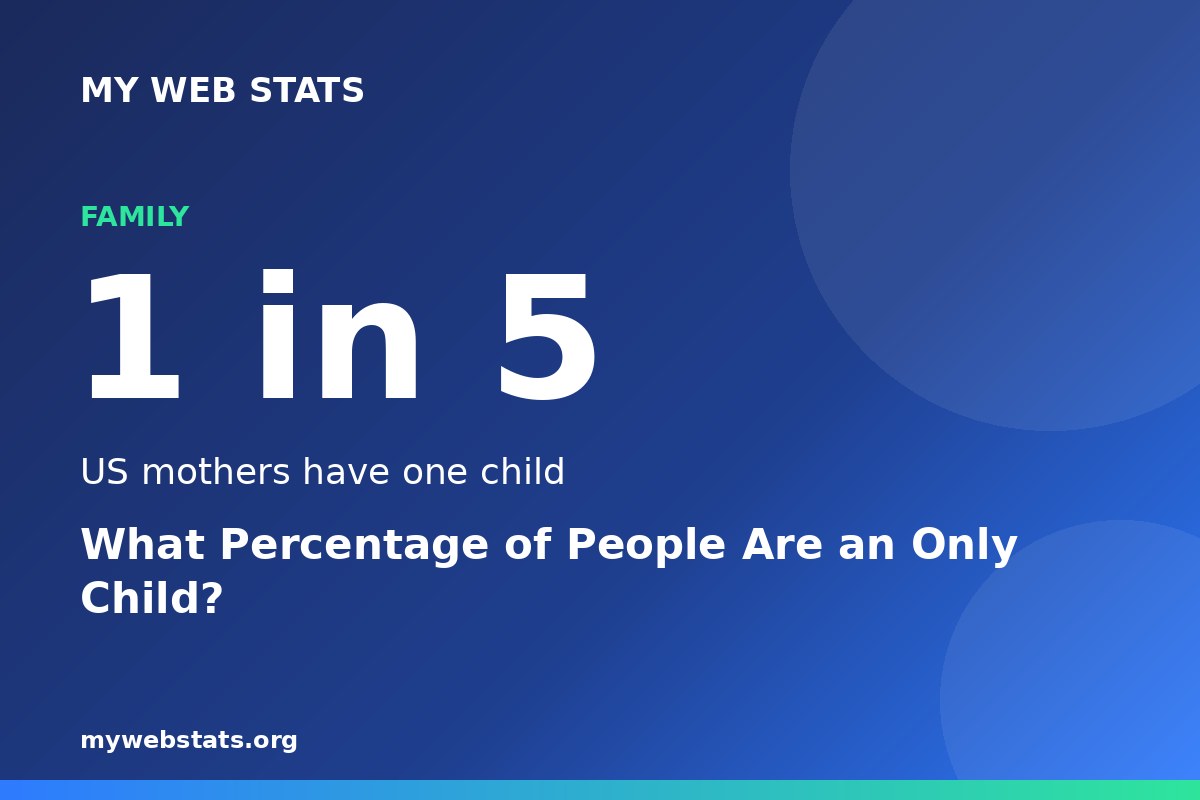
Short answer: in the US, about 1 in 5 mothers ends her childbearing years with one child, double the share in the 1970s. In the UK, around 44% of families with dependent children have just one child at any given moment, though some of those will go on to have more.
Last updated: November 2026.
Key takeaways
| Measure | Figure | Source |
|---|---|---|
| US mothers aged 40 to 44 with one child | 22% (2014) | Pew Research Center |
| Same measure in 1976 | 11% | Pew Research Center |
| UK families with dependent children that have one child | About 44% | Office for National Statistics |
| UK families with two children | About 41% | Office for National Statistics |
| UK families with three or more | About 15% | Office for National Statistics |
Why the answer depends on how you count
There are two ways to measure only children, and they give very different numbers.
- Snapshot of households: count families with one child living at home right now. This is high (44% in the UK) because it includes parents who have had their first child and not yet their second, and families whose older children have left home.
- Completed family size: count women who have finished having children with exactly one. This is lower, at about 18% to 22% in the UK and US.
- Share of all people: lower again. Larger families contain more children, so only children make up a smaller share of people than one-child families do of families. In the US it is roughly 1 in 10 children on a completed-family basis.
One-child families are becoming more common
Pew Research Center found that the share of American mothers with one child doubled between 1976 and 2014, from 11% to 22%. Over the same period the share with four or more children fell from 40% to 14%.
The reasons are familiar across wealthy countries: people are having their first child later, housing and childcare costs are high, and more women are in full-time work. In England and Wales the average age of first-time mothers is now around 29, compared with about 24 in the early 1970s.
Only children around the world
- European Union: roughly half of households with children have one child, according to Eurostat.
- China: the one-child policy ran from 1980 to 2015 and produced well over 100 million only children. Limits were raised to two children in 2016 and three in 2021.
- South Korea, Japan, Italy and Spain: very low birth rates mean one-child families are now the most common family type with children.
Is “only child syndrome” real?
The evidence says no. The idea that only children are spoiled or lonely dates from a survey published in the 1890s. A large review of 115 studies by psychologists Toni Falbo and Denise Polit found only children were no different from others in personality and sociability, and scored slightly higher on achievement and motivation. Later studies have broadly agreed.
Frequently asked questions
What is the most common family size?
For completed families in both the UK and US, two children is still the most common.
Are only children more common in cities?
Generally yes. One-child families are more common where housing is expensive and parents are older.
How many children does the average woman have?
The total fertility rate is about 1.4 in England and Wales and about 1.6 in the US, both record lows and well under the 2.1 needed to keep a population stable without migration.
Related: Odds of having twins · Odds of having a boy or a girl · Most popular baby names in England and Wales






Leave a Reply