
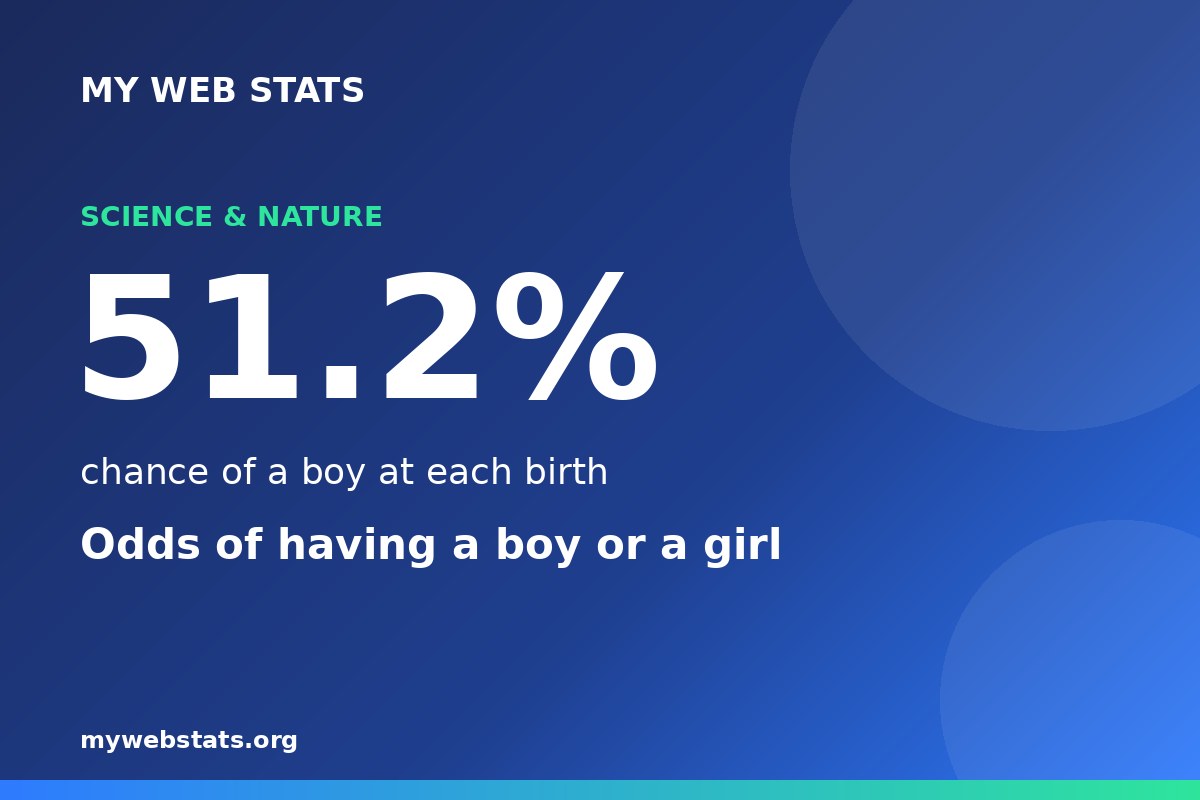
Short answer: it is close to 50:50, but not exactly. Around the world, about 105 boys are born for every 100 girls. That makes the chance of a boy about 51.2% and the chance of a girl about 48.8%.
Last updated: November 2026. General information only, not medical advice.
Key takeaways
- The natural sex ratio at birth is about 105 boys per 100 girls. The World Health Organization gives an expected range of 103 to 107.
- The sex of each baby is independent of the last one. Having three boys does not make a girl “due”.
- A study of the whole Swedish population born since 1932 found that the tendency to have boys or girls does not run in families.
- Boys and men have higher death rates at every age, so the numbers even out in adulthood and women outnumber men in old age.
Odds for two children
| Outcome | Chance |
|---|---|
| Two boys | 26.2% |
| One boy and one girl (either order) | 50.0% |
| Two girls | 23.8% |
Odds of several boys or girls in a row
| Number of children | All boys | All girls |
|---|---|---|
| 2 | 26.2% (about 1 in 4) | 23.8% (about 1 in 4) |
| 3 | 13.4% (about 1 in 7) | 11.6% (about 1 in 9) |
| 4 | 6.9% (about 1 in 15) | 5.7% (about 1 in 18) |
| 5 | 3.5% (about 1 in 28) | 2.8% (about 1 in 36) |
These are the odds before any children are born. If you already have three boys, the chance that the next baby is a boy is still about 51%.
What decides the sex of a baby?
The egg always carries an X chromosome. The sperm carries either an X or a Y. An X sperm produces a girl (XX) and a Y sperm produces a boy (XY). Sperm are made in roughly equal numbers of each type, so the father’s sperm decides the sex and the split starts out close to even.
Why are slightly more boys born?
Researchers do not fully agree. The leading explanation is that female embryos and foetuses are, overall, slightly more likely to be lost during pregnancy, which leaves a small surplus of boys at birth. After birth the pattern reverses: boys are more likely to die in infancy and men die younger on average.
Do boys or girls run in families?
The best evidence says no. A 2020 study in Proceedings of the Royal Society B analysed everyone born in Sweden since 1932, covering millions of births. It found that a person’s tendency to have sons or daughters is not inherited, and that families with all boys or all girls appear about as often as chance predicts.
Can you influence the odds?
There is no good evidence that diet, timing or position changes the sex of a baby conceived naturally. Popular methods have not held up in controlled studies.
Frequently asked questions
Is it really 50/50?
Very nearly. It is about 51.2% boys and 48.8% girls at birth.
What are the odds of three boys in a row?
About 13.4%, or roughly 1 in 7 families with three children.
What percentage of sperm carry a Y chromosome?
About half. X-bearing and Y-bearing sperm are produced in roughly equal numbers.
Related: odds of having twins · odds of being born · most popular baby names in England and Wales