
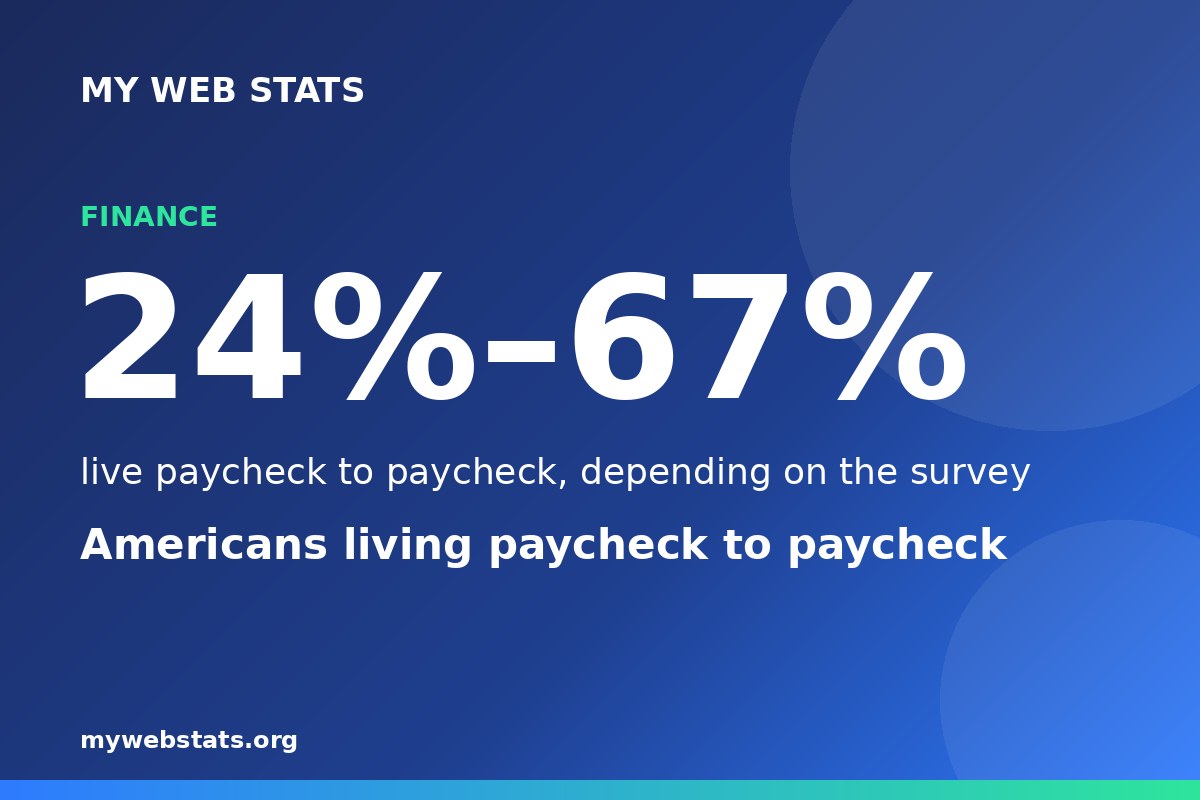
Short answer: it depends on how you measure it. Based on real spending data, about 24% of US households live paycheck to paycheck (Bank of America Institute, 2025). When people are simply asked, between 48% and 67% say they do. Both numbers are “right” — they measure different things.
Last updated: November 2026.
Key takeaways
- About 1 in 4 households spend more than 95% of their income on necessities (Bank of America’s definition).
- About 2 in 3 adults say they live paycheck to paycheck in self-reported surveys (PYMNTS, CNBC/SurveyMonkey).
- Many high earners say it too: PYMNTS found about half of people earning $100,000+ describe themselves this way.
- Living paycheck to paycheck is not always about low income — for many it is about spending and debt choices.
Every major estimate side by side
| Source | Date | Share | Method |
|---|---|---|---|
| Bank of America Institute | 2025 | ~24% of households | Account data: >95% of income spent on necessities |
| Debt.com Budgeting Survey | 2026 | 48% | Self-reported survey (down from a record 69% in 2025) |
| CNBC / SurveyMonkey | July 2026 | 63% | Self-reported survey |
| PYMNTS Intelligence | Late 2025 | ~67% (2 in 3) | Self-reported survey of ~2,000+ adults |
Why the numbers are so different
Definition. Bank of America only counts a household if more than 95% of its income goes on essentials such as housing, fuel, groceries, utilities and internet. Surveys let people decide for themselves what “paycheck to paycheck” means, and many people who spend all their income on non-essentials still say yes.
Households vs people. Bank of America measures households; surveys measure individual adults.
“By necessity” vs “by choice”. PYMNTS separates the two. The share living paycheck to paycheck out of necessity rose from 29% in December 2024 to 35% in December 2025, after peaking at 43% in September 2025.
Who is most likely to live paycheck to paycheck?
- Lower-income households: 29% met Bank of America’s strict definition in 2025, up from 27.1% in 2023.
- Younger adults: surveys consistently find Gen Z and millennials most affected.
- Even high earners: about half of those on $100k+ say they live paycheck to paycheck (PYMNTS).
How fragile are these households?
In the July 2026 CNBC/SurveyMonkey survey, 90% of those living paycheck to paycheck had less than $500 left each month after expenses, and 71% said a one-week delay in pay would cause financial problems.
What about the UK?
“Paycheck to paycheck” is an American phrase and there is no equivalent official UK statistic. UK surveys usually ask whether people could cover an unexpected bill or how much savings they have instead. See average savings in the UK and US.
Frequently asked questions
Which number should I quote?
For hard financial stress, use Bank of America’s ~24% of households. For how people feel about their finances, use the survey range of about 48–67%. Always say which one you mean.
Is the “78% of Americans live paycheck to paycheck” stat still true?
That widely shared figure comes from an older CareerBuilder survey (2017). Recent surveys find lower shares, and data-based measures are much lower still.
How do you stop living paycheck to paycheck?
The usual first steps are tracking spending for a month, building a small emergency buffer, and paying down high-interest debt. This is general information, not financial advice.
Leave a Reply