
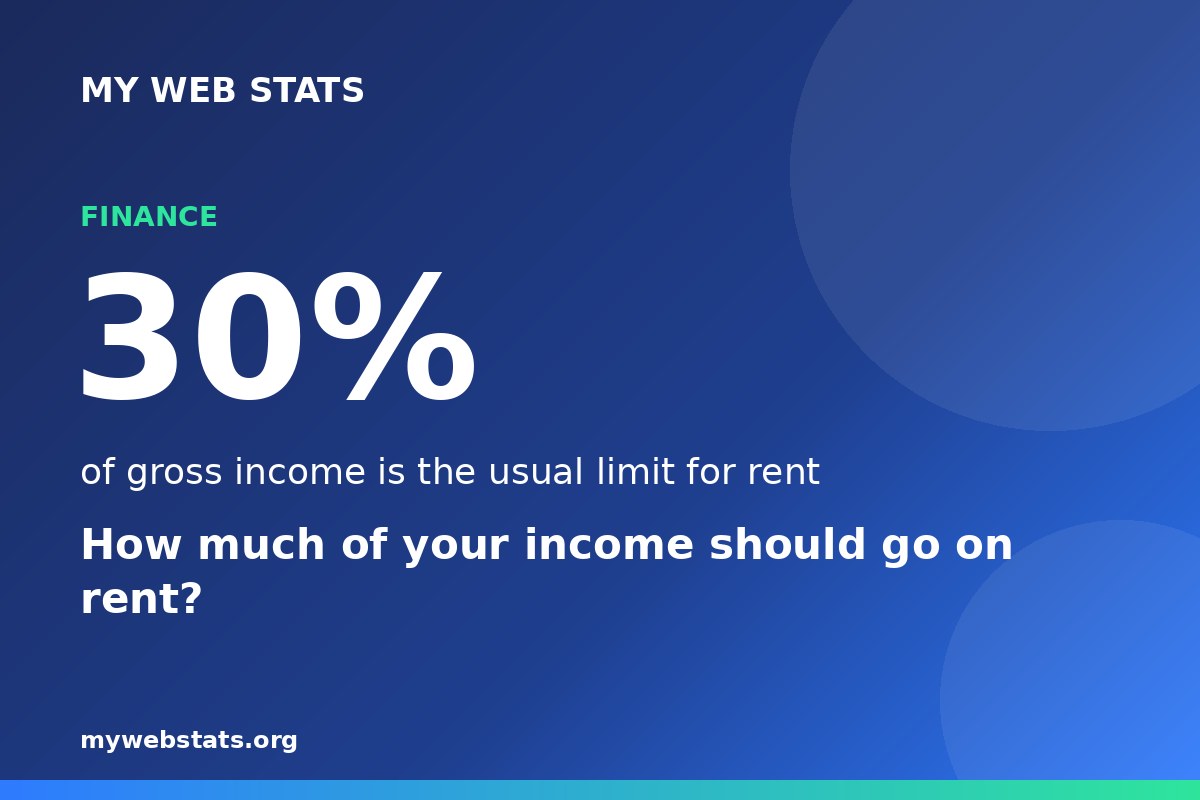
Short answer: the most widely used guide is to spend no more than 30% of your gross (pre-tax) income on rent. On a £35,000 salary that is about £875 a month. On $60,000 it is $1,500 a month.
Last updated: November 2026. General information only, not financial advice.
Rent at 30% of income
| Gross annual income | 30% per month |
|---|---|
| 25,000 | 625 |
| 35,000 | 875 |
| 50,000 | 1,250 |
| 60,000 | 1,500 |
| 75,000 | 1,875 |
| 100,000 | 2,500 |
Where the 30% rule comes from
It began in US public housing policy. Since 1981, tenants in federally assisted housing have paid 30% of their income in rent. The US Department of Housing and Urban Development (HUD) still uses the same line to measure affordability:
- Cost-burdened: spending more than 30% of income on housing.
- Severely cost-burdened: spending more than 50%.
In the UK, the Office for National Statistics also treats private rent as affordable when it is 30% or less of household income.
How landlords check affordability
| Country | Common test | Example |
|---|---|---|
| UK | Annual income of at least 30 times the monthly rent | £1,000 rent needs £30,000 income |
| US | Annual income of at least 40 times the monthly rent | $1,500 rent needs $60,000 income |
The US 40-times test is the 30% rule written another way. The UK 30-times test is looser: it allows rent of up to 40% of gross income.
Limits of the rule
- It ignores income level. 30% of a low income leaves far less to live on than 30% of a high one.
- It ignores other costs. Debts, childcare, commuting and energy bills vary widely.
- It uses gross income. After tax, the same rent is a much bigger share of take-home pay.
- Big cities break it. In London, New York and similar markets many renters pay well over 30%.
An alternative: 50/30/20
This budget splits take-home pay into 50% for needs (rent, bills, food, transport), 30% for wants and 20% for savings and debt. If rent alone takes most of the 50%, the rest of the budget is under pressure.
Frequently asked questions
Is the 30% based on gross or net income?
Gross (before tax) in the standard version. Using take-home pay is stricter and safer.
Does the 30% include bills?
HUD’s definition counts rent plus utilities. Many people apply the rule to rent only, which understates the true cost.
Related: average yearly income: UK vs US · average house price: UK vs US · Americans living paycheck to paycheck