
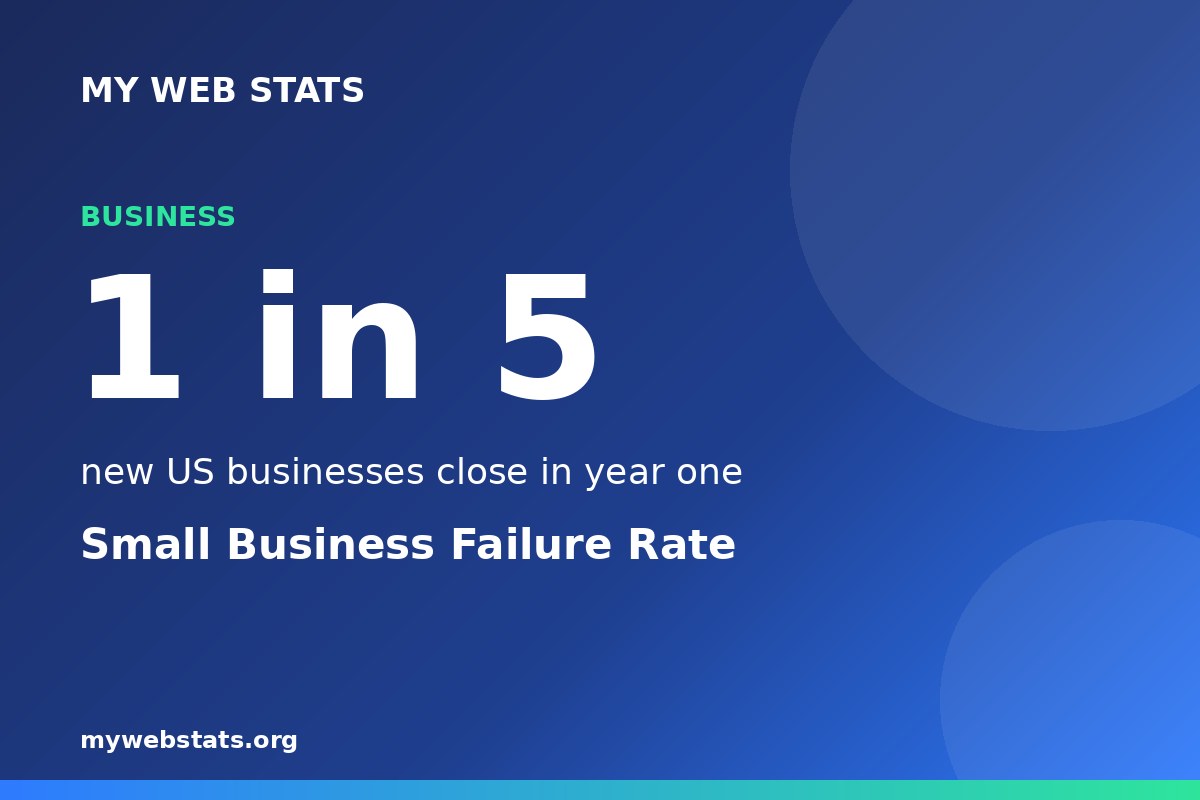
Short answer: about 1 in 5 new US businesses closes within a year, roughly half within five years and about two thirds within ten. The popular claim that “half fail in the first year” is wrong.
Last updated: November 2026. General information only, not financial advice.
Key takeaways
| Time since opening | Closed | Still trading |
|---|---|---|
| 1 year | About 20% to 22% | About 78% to 80% |
| 5 years | About 49% | About 51% |
| 10 years | About 65% | About 35% |
What the US data shows
The Bureau of Labor Statistics (BLS) follows every group of new business establishments from the year they open. For those born in 2013, 34.7% were still operating in 2023. More recent cohorts show much the same pattern: a first-year closure rate of 20% to 22%, just under half gone by year five and about 65% by year ten.
The risk falls with age. A business that reaches its fifth birthday has roughly a 70% chance of reaching its tenth. The worst first-year result since records began in 1994 was for businesses opened in 2008, at the start of the financial crisis.
Survival by industry
| Industry | Still operating after 10 years |
|---|---|
| Agriculture, forestry, fishing and hunting | 50.5% |
| Utilities | 45.7% |
| Manufacturing | 43.6% |
| All industries | 34.7% |
| Wholesale trade | 32.1% |
| Information | 29.1% |
| Mining, quarrying, oil and gas | 24.5% |
UK business survival rates
The Office for National Statistics publishes similar figures in its business demography release. UK firms do better in year one, with more than 9 in 10 surviving, partly because the data counts registered companies rather than every start-up. By year five the picture is close to the American one: only around 4 in 10 are still active.
Why small businesses close
- Cash flow: running out of money is the most commonly reported cause, often when sales are growing.
- No market need: the product or service does not attract enough paying customers.
- Costs: rent, wages, energy and borrowing rise faster than prices can.
- Competition: larger or cheaper rivals take share.
- Owner’s choice: a closure is not always a failure. Owners retire, sell up or move on to something else.
That last point matters. BLS and ONS count any closure, so “failure rate” overstates how many businesses go bust owing money.
Frequently asked questions
Do 90% of start-ups fail?
Not ordinary small businesses. The 90% figure is usually applied to venture-backed technology start-ups, and measures failure to return investors’ money, not closure.
Do restaurants fail more often?
Slightly, but far less than the “90% in year one” myth suggests. Accommodation and food services sit a little below the all-industry average for survival.
Which year is the riskiest?
The first. Each year after that, the chance of closing in the following twelve months falls.
Related: Average yearly income: UK vs US · What percentage of Americans live paycheck to paycheck? · Average savings: UK vs US