Short answer: statistics is the science of collecting, organising, analysing and interpreting data so you can describe what happened and draw conclusions under uncertainty. It has two main branches: descriptive statistics (summarising data) and inferential statistics (using a sample to draw conclusions about a population).
Last updated: November 2026.
Two meanings of “statistics”
- The field: the methods used to learn from data.
- The numbers: a “statistic” is a value calculated from a sample, such as a sample mean. “Crime statistics” or “UK population statistics” use the word in this sense.
Descriptive vs inferential statistics
| Descriptive | Inferential | |
|---|---|---|
| Goal | Summarise the data you have | Generalise from a sample to a population |
| Tools | Mean, median, mode, range, standard deviation, charts | Confidence intervals, hypothesis tests, regression |
| Example | “The average score in this class was 68” | “We are 95% confident the national average is 66–70” |
Key terms
| Term | Meaning |
|---|---|
| Population | Everyone or everything you want to study |
| Sample | The subset you actually measure |
| Parameter | A number describing a population (e.g. μ). Usually unknown. |
| Statistic | A number describing a sample (e.g. x̄). Used to estimate the parameter. |
| Variable | A characteristic you measure (age, income, eye colour) |
| Qualitative / quantitative | Categories vs numbers |
Parameter vs statistic: a quick example
The true average height of all UK adult men is a parameter. If you measure 2,000 men and get 175.3 cm, that is a statistic, your estimate of the parameter. See average height in the UK, US and worldwide.
Where statistics is used
- Government: the census, inflation, unemployment (ONS in the UK, Census Bureau in the US).
- Health: drug trials, life expectancy, disease rates.
- Business: A/B testing, forecasting, quality control.
- Sport: player ratings such as OPS.
Frequently asked questions
Is statistics part of mathematics?
It uses mathematics, especially probability, but is usually treated as its own discipline because it focuses on real, messy data and uncertainty.
Where do I start learning statistics?
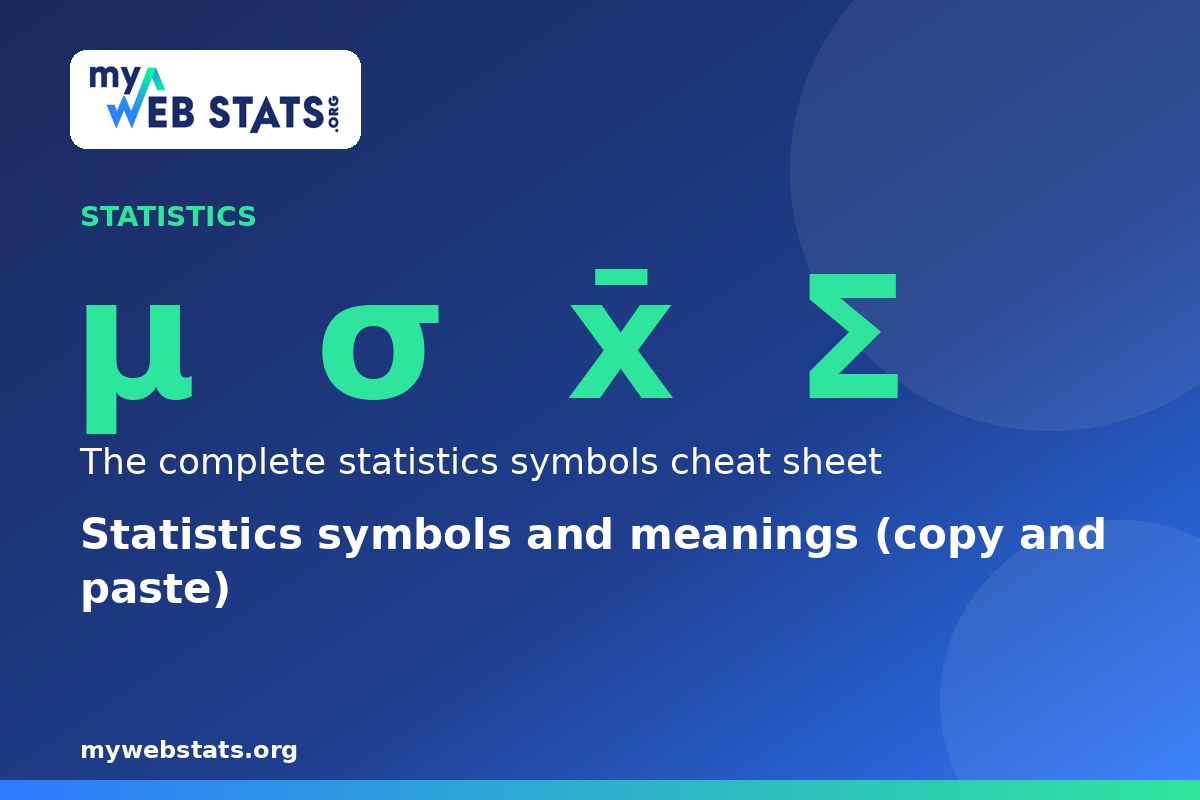
Begin with mean, median, mode and standard deviation, then sampling and confidence intervals. Our statistics symbols cheat sheet covers the notation.