

Short answer: of the main eye colours, green is the rarest. About 2% of people worldwide and 9% of Americans have green eyes, according to the American Academy of Ophthalmology. Rarer still are grey and amber eyes, red or violet-looking eyes (seen in some people with albinism), and complete heterochromia (two different coloured eyes), which affects about 1 in 1,600 people.
Last updated: November 2026.
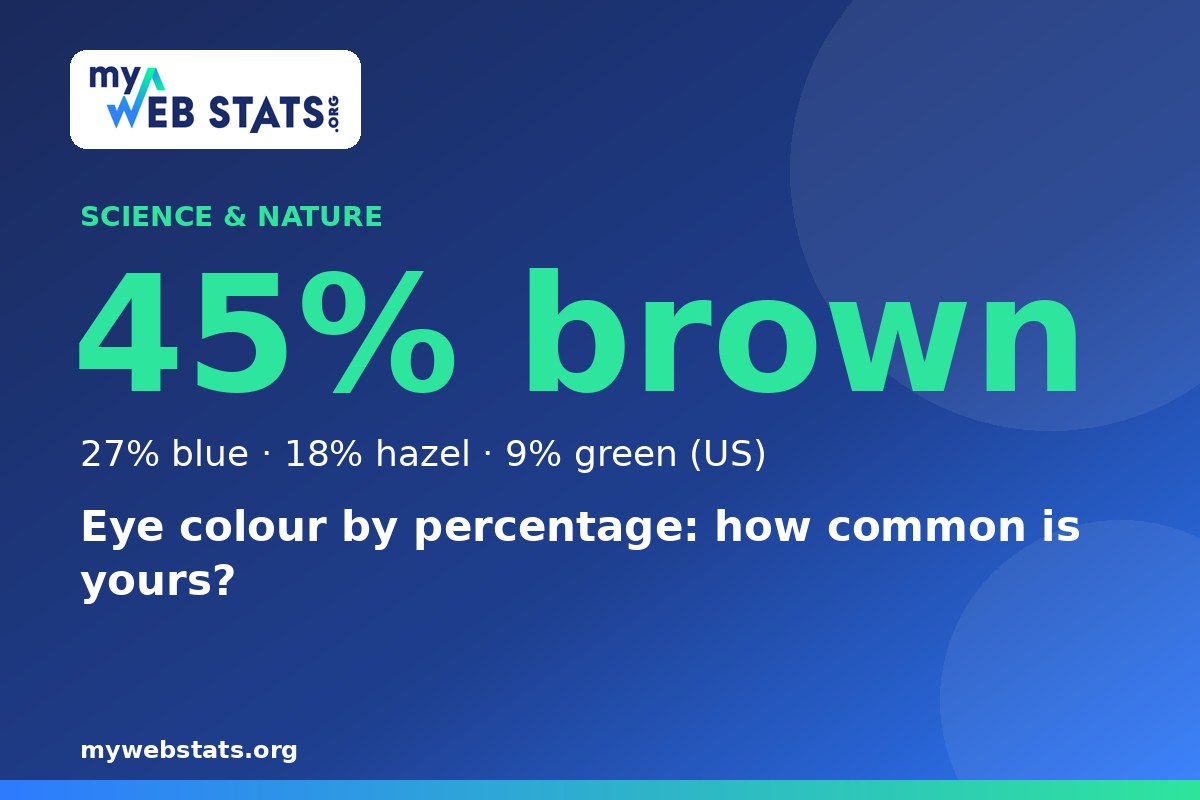
From most common to rarest (US)
45%
27%
18%
9%
1%
Source: American Academy of Ophthalmology survey of 2,000+ Americans. “Other” includes grey. Graphic by mywebstats.org.
Key takeaways
- Green is the rarest of the four main colours: about 2% of the world and 9% of Americans.
- Grey and other unusual shades together make up about 1% of Americans.
- Amber is a solid golden-copper colour. Surveys usually group it with hazel, so there is no reliable separate figure.
- Complete heterochromia (one eye a different colour from the other) affects about 0.06% of people, roughly 1 in 1,600.
- Red or violet-looking eyes occur in some people with albinism, when there is so little pigment that blood vessels show through.
Rarest eye colours ranked
| Eye colour | How common | Why it’s rare |
|---|---|---|
| Green | About 2% worldwide; 9% in the US | Needs a light brown pigment layer mixed with scattered blue light |
| Grey | Part of the 1% “other” group in the US | Very low pigment, with light scattered differently from blue eyes |
| Amber | No reliable figure (usually counted as hazel) | An even, golden tone with no green or brown flecks |
| Complete heterochromia | About 0.06% (1 in 1,600) | Each eye has a different amount of pigment |
| Red / violet | Very rare | Seen in some forms of albinism |
How rare is heterochromia?
Researchers at the US Military Academy at West Point checked over 11,000 high-resolution yearbook portraits of cadets. They found 7 people with complete heterochromia, a prevalence of about 0.06%. That closely matches an older study that examined more than 25,000 people in Vienna in the 1960s.
Partial heterochromia, where one iris has two colours, and central heterochromia, a ring of a different colour around the pupil, are more common, but there is no good population figure for them. Heterochromia present from birth is usually harmless. If one eye changes colour in adulthood, get it checked by an optometrist or eye doctor.
What are babies’ eye colours?
The Newborn Eye Screening Test (NEST) study in California found that 63% of newborns had brown eyes, 20.8% blue and 5.7% green or hazel. For 9.9%, the colour couldn’t yet be determined. Many babies’ eyes darken in the first year or two as pigment builds up.
Frequently asked questions
What is the second rarest eye colour?
Among the main colours in US data, hazel (18%) comes after green (9%). If grey is counted separately from blue, many lists put grey as rarer than green, but surveys rarely measure it on its own.
Are violet eyes real?
True violet eyes are extremely rare. Eyes that look violet or red are usually linked to albinism, where very little pigment lets the blood vessels at the back of the eye show through. Some very light blue eyes can also look violet in certain lighting.
Which country has the most green eyes?
Green eyes are most common in people of northern and central European ancestry, including Ireland and Scotland. There is no reliable country-by-country survey.
Related: Eye colour by percentage (chart) · How common are green eyes? · How common are blue eyes?
Sources
- American Academy of Ophthalmology: Your blue eyes aren’t really blue
- Dabkowski M.F. et al. (2022). Estimating the prevalence of heterochromia iridum from high-resolution digital yearbook portraits. Journal of Optometry
- All About Vision: What is the rarest eye color? (NEST newborn study figures)
- MedlinePlus Genetics: Is eye color determined by genetics?

Leave a Reply