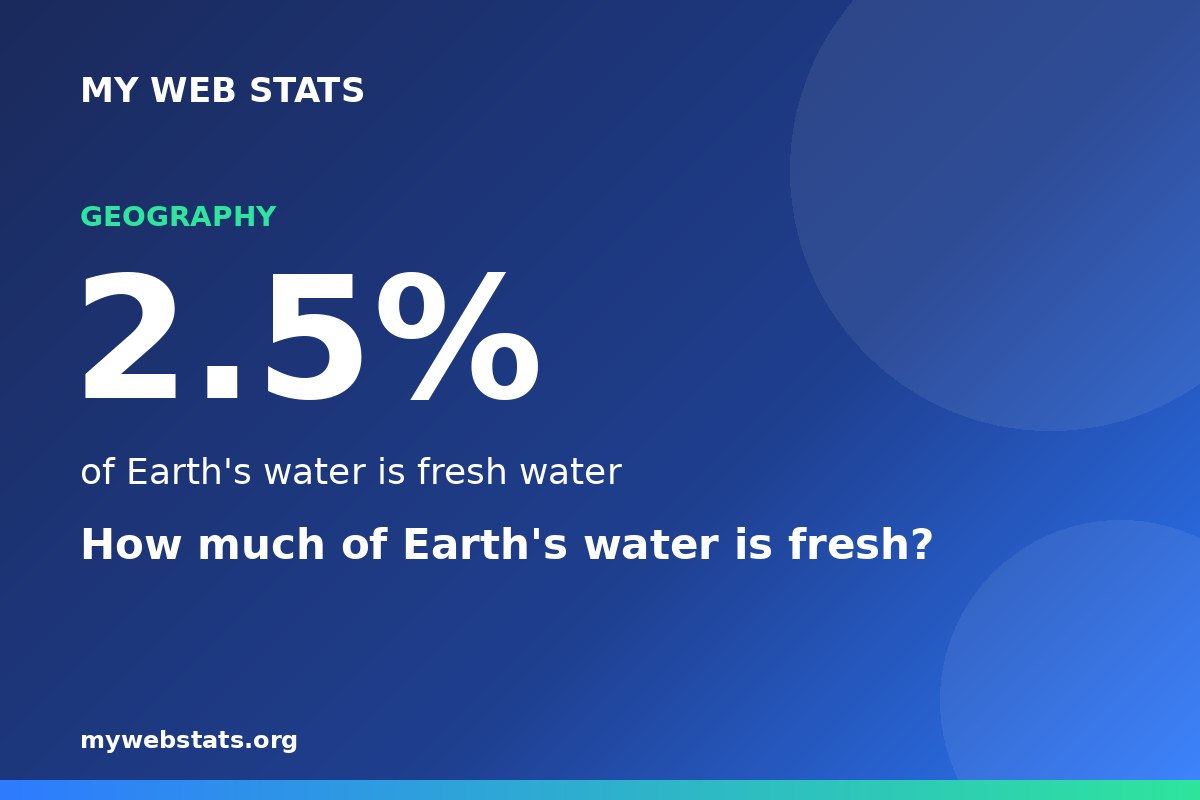
Short answer: only about 2.5% of the water on Earth is fresh water. The other 97.5% is salty. Most fresh water is out of easy reach: about 69% is frozen in glaciers and ice caps and 30% is underground. Lakes and rivers hold roughly 0.3% of it.
Last updated: November 2026.
Key takeaways
- Earth holds about 1.386 billion cubic kilometres of water. Around 96.5% of it is in the oceans.
- Fresh water is 2.5% of the total, about 35 million cubic kilometres.
- Rivers, the source many towns and farms rely on, hold only about 0.006% of all fresh water.
- Farming takes about 70% of the fresh water that people withdraw worldwide.
All of Earth’s water
| Where the water is | Share of all water |
|---|---|
| Oceans, seas and bays | 96.5% |
| Other salty water (saline groundwater and lakes) | About 1% |
| Fresh water | 2.5% |
Where the fresh water is
| Store | Share of fresh water |
|---|---|
| Glaciers and ice caps | 68.7% |
| Groundwater | 30.1% |
| Surface and other fresh water | 1.2% |
That last 1.2% is the part we see. It breaks down like this:
| Surface and other fresh water | Share of this 1.2% |
|---|---|
| Ground ice and permafrost | 69.0% |
| Lakes | 20.9% |
| Soil moisture | 3.8% |
| Atmosphere | 3.0% |
| Swamps and marshes | 2.6% |
| Rivers | 0.49% |
| Living things | 0.26% |
How much can we actually use?
Very little. Lakes and rivers together hold about 0.26% of the world’s fresh water. Measured against all water on the planet, that is under 0.01%. If all of Earth’s water filled a 1-litre bottle, the fresh water in lakes and rivers would be less than two drops.
Groundwater is far bigger than lakes and rivers combined, which is why so many countries pump it for drinking water and irrigation. The catch is that deep groundwater can take centuries to refill.
Where is the ice?
Almost all of it is in two places. The ice sheets of Antarctica and Greenland contain more than 99% of the fresh-water ice on Earth, according to the US National Snow and Ice Data Center.
Who uses the fresh water?
The UN Food and Agriculture Organization estimates that agriculture accounts for about 70% of global fresh-water withdrawals. Industry and households share the rest.
Frequently asked questions
What percentage of Earth’s water is drinkable?
Fresh water is 2.5% of the total, but most is frozen or deep underground. The share that is liquid, fresh and easy to reach in lakes and rivers is under 0.01% of all water on Earth.
How much of Earth is covered by water?
About 71% of the surface. See our post on how much of Earth is land.
Is there more fresh water in the air or in rivers?
In the air. The atmosphere holds about six times as much water as all the world’s rivers at any one moment.
Related: how much does a cloud weigh · what percentage of the human body is water · oxygen in the atmosphere