
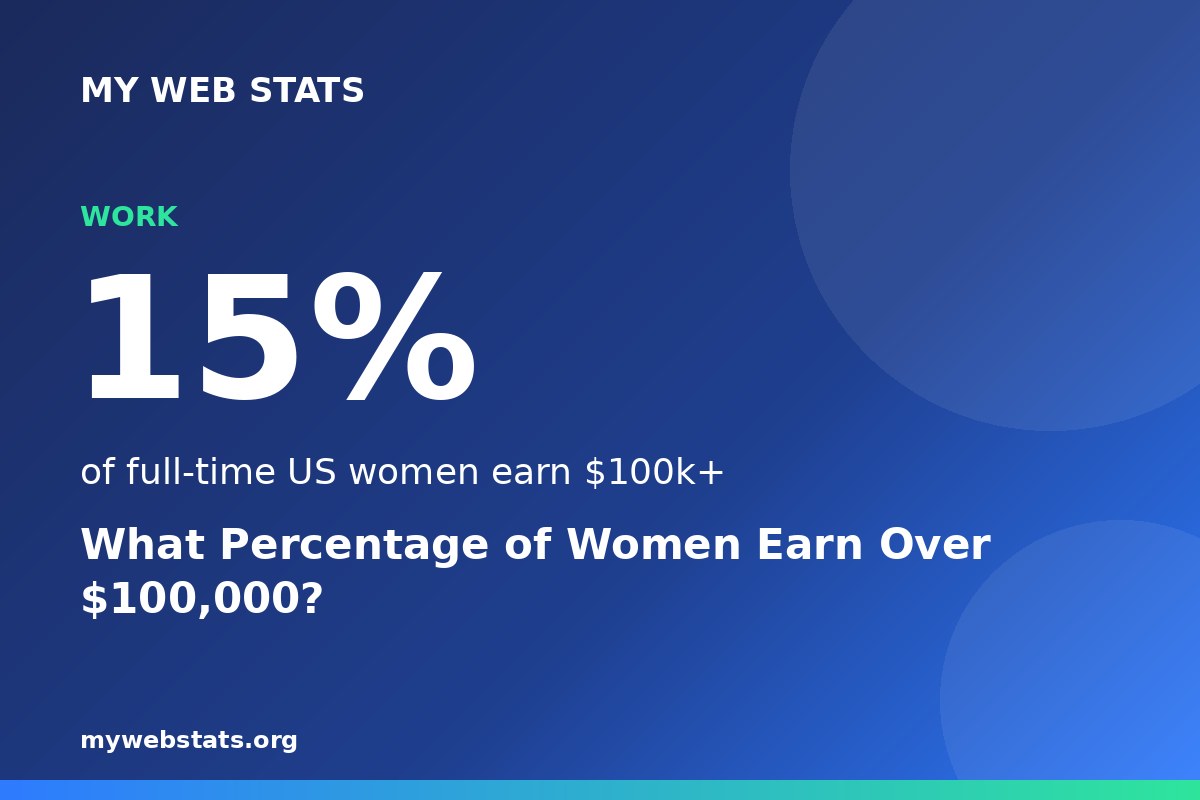
Short answer: roughly 15% of American women who work full time, year round, earn $100,000 or more, compared with about a quarter of men. Counting all women with any earnings, including part-time workers, the share is closer to 1 in 10. These are estimates from Census Bureau income tables and move a little each year.
Last updated: November 2026. Rounded estimates; see the sources for exact annual tables.
Key takeaways
| Group (US) | Share earning $100,000 or more (approx.) |
|---|---|
| Women working full time, year round | About 15% |
| Men working full time, year round | About 25% |
| All women with earnings | About 10% |
| All men with earnings | About 20% |
- The median for women working full time in the US is a little over $55,000 a year, so $100,000 is nearly double typical pay.
- The share of women above $100,000 has grown several-fold since 2000, even after allowing for inflation.
- Women are about a third of all Americans earning six figures.
Why the measure matters
You will see very different percentages quoted, because the answer depends on who is in the denominator.
- Full-time, year-round workers: the highest figure, because it excludes part-time and part-year work.
- All earners: lower, since women are more likely than men to work part time.
- All adult women: lower again, because it includes those not in paid work.
- Households: a different question. Around 4 in 10 US households have a combined income above $100,000.
Where six-figure earners work
High earners of both sexes are concentrated in management, medicine, law, technology, finance and engineering. Women now earn the majority of US bachelor’s, master’s and doctoral degrees, and their share of doctors, lawyers and managers has risen steadily, which is the main driver of the long-term increase.
The gap with men is widest at the top. Men are over-represented in the highest-paying specialties and in senior executive roles, and earnings differences widen after couples have children.
United Kingdom
£100,000 is a far higher bar in Britain, where median full-time pay is around £39,000. HM Revenue and Customs data show roughly 4% of UK taxpayers have incomes above £100,000, and only about a quarter of them are women. That puts the share of women taxpayers above £100,000 at around 1% to 2%.
Frequently asked questions
What is the gender pay gap?
In the US, women working full time earn about 83 to 84 cents for every dollar earned by men at the median. In the UK the gap for full-time employees is about 7%.
Is $100,000 still a high income?
For an individual, yes: it is in roughly the top fifth of US full-time earners. Its buying power has fallen, though. $100,000 in 2000 is equivalent to more than $180,000 today.
In how many couples does the woman earn more?
Pew Research Center found that in 16% of US opposite-sex marriages the wife is the main or sole earner, and in a further 29% the spouses earn about the same.
Related: Average yearly income: UK vs US · What percentage of accountants are women? · What percentage of surgeons are women?






Leave a Reply