
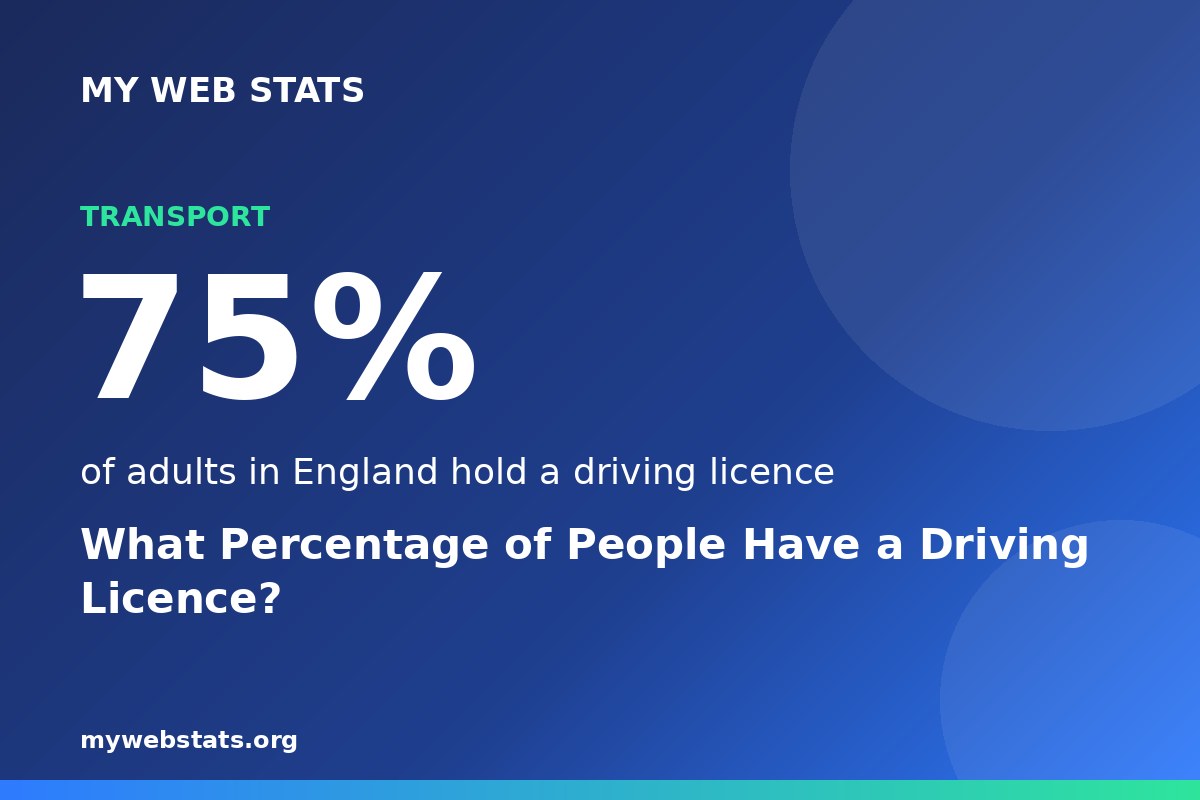
Short answer: about three quarters of adults in England hold a full car driving licence, according to the National Travel Survey. In the United States, where there are around 238 million licensed drivers, the share is close to 9 in 10 people of driving age.
Last updated: November 2026. Figures are rounded from recent official surveys.
Licence holding at a glance
| Measure | England / Great Britain | United States |
|---|---|---|
| Adults with a full licence | About 75% of those aged 17 and over | Close to 90% of those aged 16 and over |
| Number of licence holders | More than 42 million in Great Britain | About 238 million |
| Men | About 80% | Similar to women |
| Women | About 71% | Similar to men |
| Minimum age for a car | 17 | Usually 16, set by each state |
The gap between men and women has closed
In the mid-1970s, about 7 in 10 men in Britain held a licence but fewer than 3 in 10 women. The gap has narrowed in every decade since and has almost vanished among people under 50. It remains only among the oldest drivers, many of whom grew up when it was unusual for women to learn.
Young people are learning later
- In England, fewer than 3 in 10 people aged 17 to 20 hold a full licence. In the early 1990s it was nearly half.
- In the US, about a quarter of 16-year-olds are licensed, compared with nearly half in the early 1980s.
- The reasons given most often are the cost of lessons, tests and insurance, more years in education, and living in cities where a car is less useful.
- Most of them do learn eventually. By their thirties, licence holding is close to that of earlier generations.
Minimum driving ages
| Country | Minimum age for a car |
|---|---|
| United Kingdom | 17 (16 for a moped) |
| United States | Varies by state, from 14 years 3 months in South Dakota to 17 in New Jersey |
| Australia | 16 to 18, depending on the state or territory |
| Most of Europe | 18, with supervised driving from 17 in several countries |
A short history
- 1888: Carl Benz received a written permit to drive his car on public roads in Germany, after neighbours complained about the noise and smell.
- 1903: Prussia made licences compulsory.
- 1904: licences became mandatory in the UK under the Motor Car Act 1903. No test was needed.
- 1913: New Jersey became the first US state to require every driver to pass an exam.
- 1934: the UK introduced a compulsory driving test.
Frequently asked questions
What is the UK driving test pass rate?
A little under half of practical tests are passed. The theory test pass rate is similar.
Is there an upper age limit?
No. In the UK, drivers must renew their licence at 70 and every three years after that, declaring that they are fit to drive.
How many households have no car?
About 22% in England and about 8% in the US.
Related: Average miles driven per year · How many cars are there in the world? · Distracted driving statistics






Leave a Reply