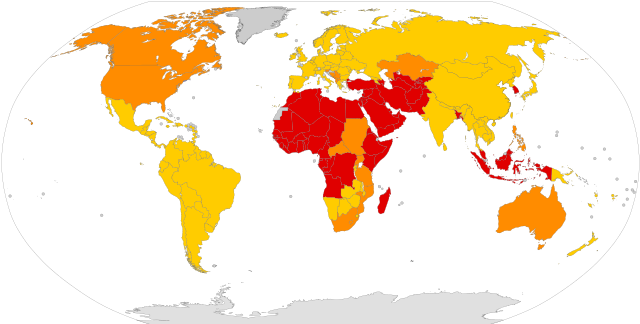
Short answer: about 37–39% of men worldwide are circumcised, roughly 1 in 3, according to the most detailed country-by-country estimate (Morris et al., Population Health Metrics, 2016). Rates range from near-universal in Muslim-majority countries and Israel to under 5% in much of Europe.
Last updated: November 2026.
Estimated circumcision rates by country
| Country | Estimated share of men circumcised |
|---|---|
| Iran, Iraq, Yemen, West Bank | 99–100% |
| Indonesia | 93% |
| United States | 71–80%* |
| New Zealand | 33% |
| Australia | 27% |
| United Kingdom | 21% |
| France | 14% |
| Germany | 11% |
| Sweden | 5% |
| Italy | 3% |
| Ireland | 1% |
*The original paper listed the US at 70–71%; a published correction changed it to 80.5%, citing a different survey. Source: Morris et al. (2016) and University of Sydney summary.
Why rates differ so much
- Religion and culture: about half of all circumcisions are for religious or cultural reasons, mainly in Muslim and Jewish communities.
- Medical custom: newborn circumcision became routine in the US in the 20th century, but not in most of Europe.
- HIV prevention: voluntary medical male circumcision programmes have raised rates in several eastern and southern African countries.
How the estimate was made
The researchers combined published surveys, Demographic and Health Surveys and AIDS Indicator Surveys for 237 countries and territories. Where no data existed, they assumed near-universal circumcision among Muslim and Jewish men and a minimum medical rate for everyone else, so some country figures are estimates with wide uncertainty.
Frequently asked questions
Is circumcision becoming more or less common?
Globally the share was rising in 2016, mainly because of HIV programmes in Africa and higher birth rates in countries where it is common. In the US, newborn rates have drifted down since the 1980s.
Is circumcision recommended in the UK?
The NHS does not offer routine circumcision for non-medical reasons. It is done for specific medical conditions or privately. Speak to a GP for medical advice.