
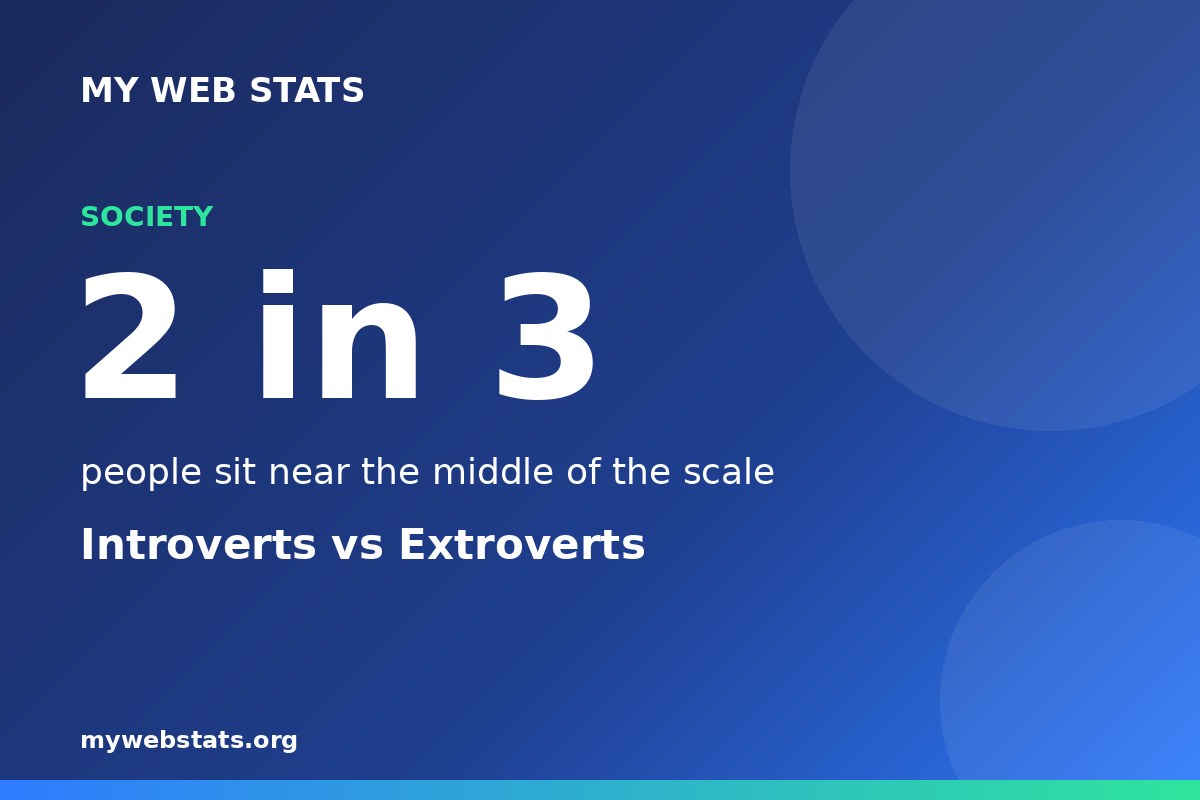
Short answer: when a test forces everyone into one of two boxes, the result is close to half and half, with introverts slightly ahead in some large samples. But psychologists measure extraversion as a scale, and most people fall near the middle of it. Around two thirds are neither strongly one nor the other.
Last updated: November 2026.
Figures you will see quoted
| Claim | Where it comes from | How solid it is |
|---|---|---|
| About 50% introverts, 50% extroverts | Myers-Briggs Type Indicator samples, including a US national sample that found a slight introvert majority | Reasonable for a forced two-way split |
| “Introverts are 25% of people” | An early estimate from the 1960s, repeated ever since | Not supported by later data |
| “A third to a half are introverts” | Popular books on introversion | A fair summary of the range |
| “Most people are ambiverts” | The bell-curve shape of scores on research questionnaires | Well supported |
Why there is no single percentage
Extraversion is one of the “Big Five” personality traits used in research, alongside openness, conscientiousness, agreeableness and emotional stability. Scores on it follow a bell curve, like height. Asking what percentage of people are introverts is like asking what percentage are tall: the answer depends entirely on where you draw the line.
| Position on the scale | Share of people in a normal distribution |
|---|---|
| Clearly introverted (more than one standard deviation below average) | About 16% |
| Middle range, often called ambiverts | About 68% |
| Clearly extroverted (more than one standard deviation above average) | About 16% |
What the terms mean
- Extraversion covers sociability, talkativeness, assertiveness, energy and seeking stimulation.
- Introversion is the lower end of the same scale: a preference for quieter settings and fewer, closer interactions.
- It is not shyness. Shyness is anxiety about social situations. An introvert may be perfectly confident and simply prefer less of them.
- It is not fixed in every setting. Most people act more outgoing in some situations and more reserved in others.
What research does show
- Heritability: twin studies suggest around 40% to 60% of the variation is genetic.
- Age: average scores on the sociable, energetic side of the trait decline slightly through adulthood.
- Countries: average scores differ modestly between nations, though translation and cultural norms make comparisons uncertain.
- Work: a study of salespeople by Adam Grant found those in the middle of the scale sold more than either strong extroverts or strong introverts.
Frequently asked questions
Is the Myers-Briggs test reliable?
It is popular, but psychologists criticise it for sorting people into two categories when scores cluster in the middle. A sizeable share of people get a different type when they retake it.
Is it extrovert or extravert?
Both are used. “Extravert” is the original spelling and the one preferred in research; “extrovert” is more common in everyday writing.
Are extroverts happier?
On average they report slightly more positive emotion in surveys. The difference is modest, and many introverts report high life satisfaction.
Related: IQ distribution · What percentage of people have an inner monologue? · Is communication 93% nonverbal?
Leave a Reply