
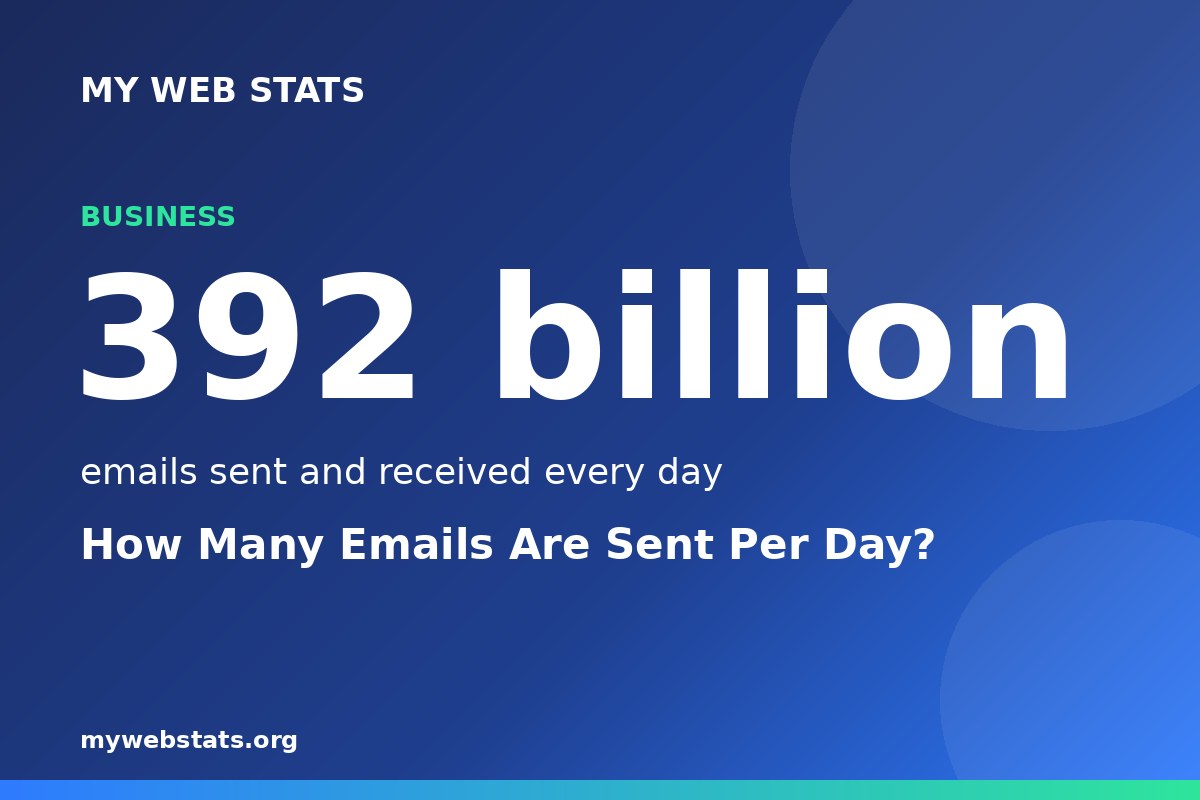
Short answer: about 392 billion. The Radicati Group, the research firm whose figures are most widely quoted, estimates that 392.5 billion emails are sent and received worldwide every day in 2026. That is roughly 4.5 million every second.
Last updated: November 2026. Figures are industry estimates and forecasts, not exact counts.
Daily email volume by year
| Year | Emails sent and received per day |
|---|---|
| 2024 | 361.6 billion |
| 2025 | 376.4 billion |
| 2026 | 392.5 billion |
| 2027 (forecast) | 408.2 billion |
| 2028 (forecast) | 424.2 billion |
Volume is growing by about 4% a year, despite the rise of messaging apps and workplace chat tools.
Breaking the number down
| Period | Emails (2026) |
|---|---|
| Per second | About 4.5 million |
| Per minute | About 273 million |
| Per hour | About 16.4 billion |
| Per day | 392.5 billion |
| Per year | About 143 trillion |
Around 4.7 billion people use email, more than half the world’s population. Spread evenly, that is about 83 emails per user each day, though the real distribution is very uneven.
How much of it is spam?
Security firms that monitor mail traffic estimate that close to half of all email is spam. Kaspersky’s annual reports have put the share at around 45% to 47% in recent years. Most of it is caught by filters and never reaches an inbox. Automated messages, such as receipts, alerts and newsletters, make up a large part of the rest. Emails written by one person to another are a minority of the total.
Email at work
- Surveys of office workers put the average at about 120 emails received and about 40 sent each working day.
- Several studies estimate that knowledge workers spend two hours or more a day reading and answering email.
- Most email is now opened on a phone first.
Why the figure is an estimate
Nobody can count every email. Mail travels between millions of independent servers with no central record. Radicati builds its figure from surveys of providers and businesses, then projects forward. The numbers for future years are forecasts made in advance, so they should be read as a guide to scale and not as a measurement.
Frequently asked questions
When was the first email sent?
In 1971, by the American engineer Ray Tomlinson, who also chose the @ sign for addresses.
Which email service is the biggest?
Gmail, with around 1.8 billion users, followed by Apple’s and Microsoft’s services.
Does email have a carbon footprint?
A small one per message, from the electricity used by devices and data centres. Estimates range from a fraction of a gram of CO2 for a short email to tens of grams for one with large attachments.
Related: WhatsApp statistics · Cyber attack statistics · Average typing speed

Leave a Reply