
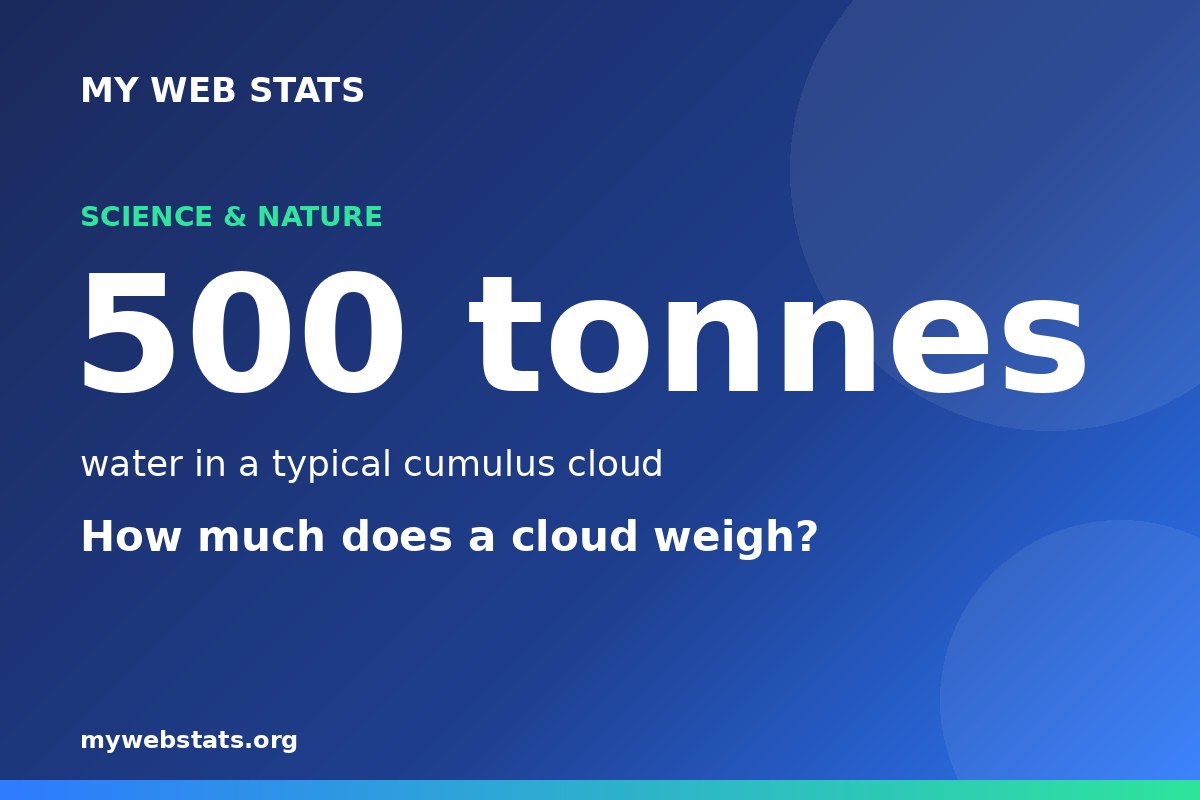
Short answer: A typical fair-weather cumulus cloud of about one cubic kilometre holds roughly 500,000 kg of water, about 1.1 million pounds, according to the US Geological Survey. That is about the weight of 100 elephants.
Last updated: November 2026
500,000kgWater in a typical cumulus cloud
0.5g/m³Water density in the cloud
≈100Elephants’ worth of weight
Key takeaways
- The estimate assumes a 1 km × 1 km × 1 km cloud with 0.5 g of water per cubic metre.
- 1 billion m³ × 0.5 g = 500 million g = 500 tonnes.
- Storm clouds (cumulonimbus) are far bigger and can hold millions of tonnes.
- Clouds float because the water is spread as tiny droplets held up by rising air.
The maths
| Step | Value |
|---|---|
| Cloud volume | 1 km³ = 1,000,000,000 m³ |
| Liquid water density | 0.5 g per m³ |
| Total water | 500,000,000 g |
| In kilograms | 500,000 kg (≈1.1 million lb) |
Different clouds, different weights
Rough water content (tonnes, illustrative)
Cumulonimbus (storm)millions t
Large cumulus5,000 t
Typical cumulus500 t
Why doesn’t it fall?
Cloud droplets are tiny, around 0.01 mm across, so they fall extremely slowly and are held up by rising air currents. The air the cloud sits in also weighs far more than the water droplets.
FAQ
Does a rain cloud weigh more?
Yes. Rain and storm clouds are larger and denser.
How much water is in the whole atmosphere?
If it all fell at once it would cover the Earth about 2.5 cm (1 inch) deep (USGS).
Is a cloud heavier than a plane?
A typical cumulus outweighs a fully loaded Boeing 747-400, which tops out at roughly 400 tonnes at take-off.





Leave a Reply