
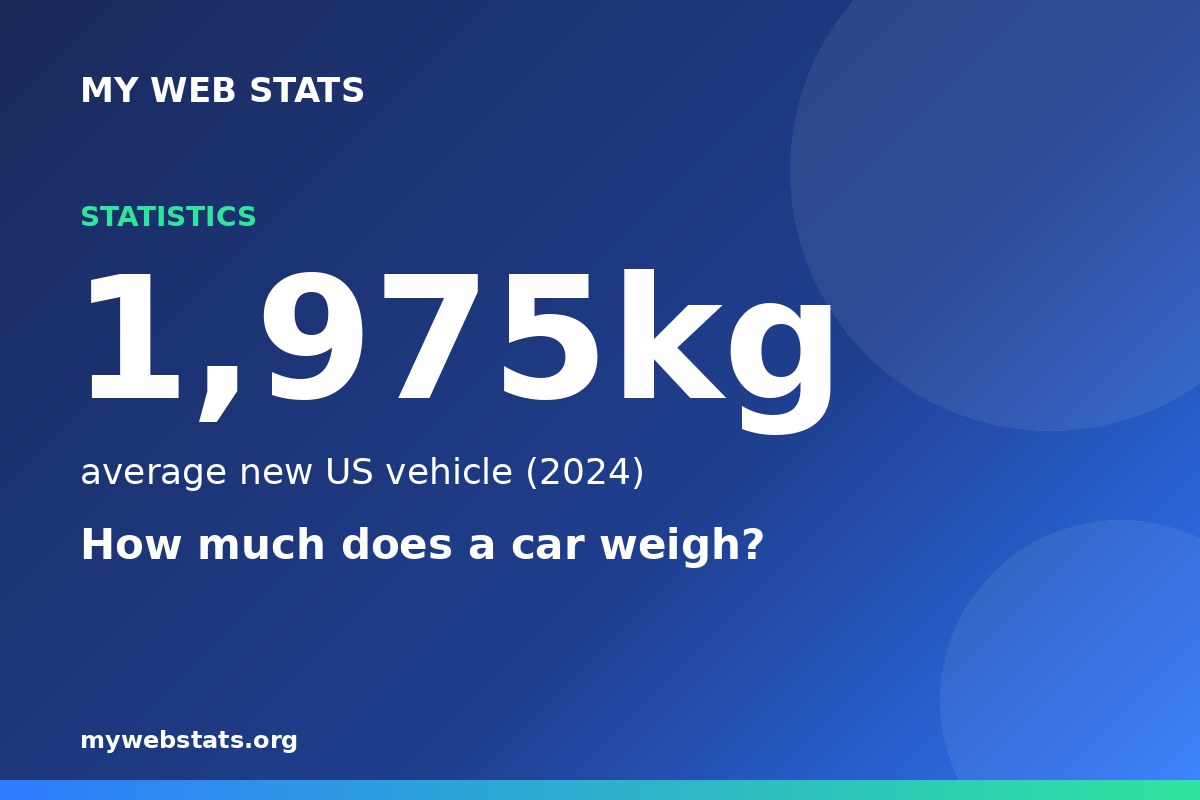
Short answer: The average new vehicle sold in the US weighed 4,354 lb (about 1,975 kg) in model year 2024, according to the EPA. A typical UK hatchback is far lighter at around 1,100–1,400 kg.
Last updated: November 2026
Key takeaways
- US vehicles are heavy because SUVs and pickups make up most sales: truck SUVs alone are half of new production.
- Average US new-vehicle weight was 4,060 lb in 1975 and peaked at 4,372 lb in 2023.
- Electric cars are typically 300–600 kg heavier than equivalent petrol cars because of the battery.
- Heavier vehicles wear roads and tyres faster and are more dangerous to pedestrians.
Weight by vehicle type
Full-size pickup2,400 kg
Large SUV2,300 kg
Electric SUV2,200 kg
Mid-size saloon1,550 kg
Hatchback (e.g. Ford Fiesta)1,150 kg
City car950 kg
Popular models
| Model | Weight |
|---|---|
| Toyota Yaris | ≈1,100 kg |
| Volkswagen Golf | ≈1,300 kg |
| Tesla Model 3 | ≈1,800 kg |
| Range Rover | ≈2,500 kg |
| Ford F-150 | ≈2,000–2,700 kg |
Kerb weight vs gross weight
Kerb weight is the car with fluids and a full tank but no passengers. Gross vehicle weight (GVW) is the maximum legal weight including people and luggage, shown on the VIN plate.
FAQ
How much does an average UK car weigh?
Roughly 1,300–1,500 kg across the fleet, with SUVs pushing the average up.
How much does a Mini weigh?
The modern Mini Cooper weighs around 1,200–1,300 kg; the original 1959 Mini was about 600 kg.
Can I drive a 3,500 kg vehicle on a car licence?
In the UK a standard category B licence covers vehicles up to 3,500 kg maximum authorised mass.






Leave a Reply