
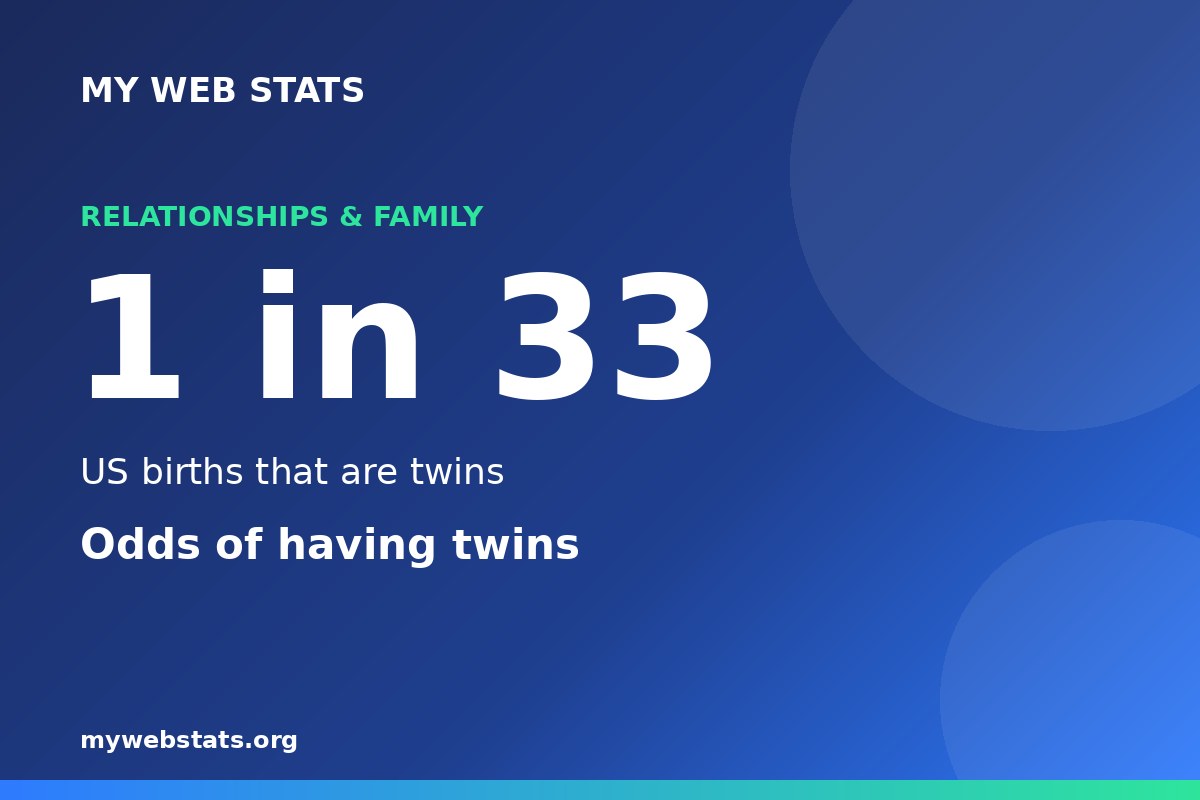
Short answer: In the US, 30.1 of every 1,000 babies were born as twins in 2024, about 1 in 33, according to the CDC. In the UK, roughly 1 in 70 pregnancies that end in birth is a multiple pregnancy.
Last updated: November 2026
1 in 33US babies born as twins
30.1Twins per 1,000 US births, 2024
−11%Fall in US twin rate since 2014
Key takeaways
- The US twin birth rate rose 79% from 1980 to a peak of 33.9 per 1,000 in 2014, then fell 11% by 2024.
- IVF and older maternal age drove the earlier rise; single-embryo transfer drove the fall.
- Identical twins happen in about 3–4 of every 1,000 births worldwide, regardless of family history.
- Fraternal twins run in families through the mother.
US twin birth rate over time
Twins per 1,000 births (US)
198018.9
201433.9
202231.2
202330.7
202430.1
What raises the odds of fraternal twins?
- Being over 30, especially 35–39.
- A family history of fraternal twins on the mother’s side.
- Fertility treatment, especially multiple-embryo IVF.
- Having had several previous pregnancies.
- Being taller or having a higher BMI (small effect).
Triplets and more
In 2024 there were 71.3 triplet-or-higher births per 100,000 US births, about 1 in 1,400.
FAQ
What are the odds of identical twins?
About 3–4 per 1,000 births.
Can twins have different fathers?
Very rarely, through a process called heteropaternal superfecundation.
Which country has the most twins?
Benin and other West African countries have the highest natural twinning rates.




Leave a Reply