Less than 10% of the surface of Venus is characterized as continental-sized highlands. This means that the rest of the surface is primarily lowlands or plains.
Why is the surface of Venus so hot?
The surface of Venus is so hot that it is almost impossible to survive on it. The planet’s atmosphere is composed of greenhouse gas carbon dioxide and sulfuric acid, which makes the surface very hot and thick. The surface temperature can reach up to 900 degrees Fahrenheit, enough to melt lead.
Who discovered that the surface of Venus was noxious and hot?
The concept was put forth in 1967 by well-known astronomer Carl Sagan and biologist Harold Morowitz, and scientists have since theorized about it. Finding concrete proof of life on a hostile planet like Venus is difficult. Some probes deployed to Venus have melted as they descended to the surface, yet none have found proof of life.
What are some of the surface features on Venus that are similar to the earth?
Similar to the Earth, some surface features on Venus include mountains, craters, valleys, and lava plains. These features help to create a healthy climate on the planet.
Why has it been so difficult to examine the surface of venus with unmanned probes?
There have been many unsuccessful attempts to explore the surface of Venus due to its dense atmosphere. This atmosphere is so thick that it blocks all incoming signals from Earth, making it difficult for scientists to study the surface. Unmanned probes sent to Venus have also had difficulty reaching the surface because of the strong winds and temperatures. However, recent technological advancements may make it possible to explore the surface of Venus in the future.
What was the primary technique used to study the solid surface of venus?
Scientists were able to study Venus’s surface using various techniques, but the primary one was analyzing its radar data. Scientists learned a lot about the planet’s composition and morphology by studying how the radar waves bounce off of the surface. Additionally, by analyzing photos and videos taken by spacecraft, scientists could also better understand what is happening on the surface.
What is the force of gravity at the surface of Venus?
The force of gravity at the surface of Venus is about 8.87 m/s², almost the same as on Earth. The difference in gravity is caused by the atmosphere of Venus, which is much thicker than Earth’s atmosphere. This extra mass makes it harder for objects to escape from the planet’s gravitational pull. We calculate Venus’s weight by dividing the Earth’s weight by the Earth’s force of gravity, which is 9.81m/s2.
What keeps the surface of Venus looking so young?
Venus is one of the most fascinating planets in our solar system. Venus has a very active surface. The planet’s atmosphere and the scorching sun constantly erode and rebuild the surface, along with ongoing volcanism. This ongoing process helps explain why Venus looks so young, despite being billions of years old.
What color is the surface of Venus?
Many people are curious about the surface of Venus. Although it is very far away from Earth, scientists have been able to study it using telescopes. They have found that Venus’ surface appears yellow-white in color with a rustic appearance due to the planet’s mountains and large volcanoes.
The tropics account for 36% of the Earth’s landmass and serve as a home to about a third of the world’s people. They are basically regions of the Earth that lie roughly in the middle of the globe. The tropics consist of the Equator and parts of North America, South America, Africa, Asia, and Australia.
What imaginary lines mark the southern and northern boundaries of the tropics?
The English word “tropic” derives from the Greek word “tropikos,” which means “belonging to a turn of the sun at the solstice.”
The southern limit of the tropics is marked by the line known as the Tropic of Capricorn, whose latitude is 23° 27′ S. Because the sun was in the constellation Capricorn at the time of its naming, which occurred at the December solstice, it was given that name.
On the other hand, the line called the Tropic of Cancer marks the northern boundary of the tropics, and its latitude (distance from the Equator) is 23° 27′ N. Likewise, the name was from the idea that the sun was positioned in the Cancer constellation during the June solstice.
The naming happened around 2000 years ago, and the sun is no longer in those constellations at that time of year.
Why are the tropics the most diverse areas?
The tropics are very diverse regions of the world because they have the most varied environments. They are hot and humid, so they contain a wide variety of plants and animals. The climate is also quite stable, so there are lots of different types of trees, plants, and flowers.
Tropical latitudes produce far more solar energy than temperate zones, which results in high productivity and high biodiversity. Tropical regions tend to have fewer seasonal changes than temperate ones and their climates are more or less stable. This encourages specialization within the niche and hence a large number of animals.
Why do hurricanes initially form only in the tropics?
Tropical cyclones are similar to engines that need warm, moist air as their fuel. So the first ingredient required for a tropical cyclone to form is warm ocean water. That is why tropical storms only form in tropical regions where the oceans are at least 80 degrees Fahrenheit for at least the top fifty meters below the surface.
A tropical cyclone also requires wind to be formed. When hurricanes form in the Atlantic Ocean, they’re usually caused by winds blowing westward across the ocean from Africa. Water evaporates from the surface of the ocean, rising into the air. As it rises, the water vapor cools and condenses back into large water droplets, forming larger cumulonimbus cloud formations. These clouds are just a start.
Rainfall varies greatly from one region of the tropics to another. For example, some parts of the Amazon Basin in South America receive almost 3 meters (9 feet) of rain per year. Dry climates are found in other parts of the tropics. The Sahara Desert in northern Africa only receives between 2-10 centimeters (793.9 inches) of rain per year.
Rainfall directly affects which plants and animals thrive in a particular tropical region. The baobab tree thrives in arid tropical climates, such as Africa. It stores water in its huge trunk. On the other side is the rainy island of Sri Lanka located in the Indian Ocean. Sri Lanka gets enough precipitation to support 250 species of frogs.
The tropics receive more direct solar energy, which results in more evaporation than in higher latitudes. The warm, moist atmosphere rises, forms clouds and thunderstorms and then falls back to earth as rain. More evaporation means more precipitation.
What temperature range characterizes the wet tropics?
The average temperature in the tropics is about 80 degrees (27 Celsius). The temperature feels warmer because the humidity is usually quite high. Humidity is the amount of water in the air. During the day, temperatures rarely exceed 93 degrees, and at night, temperatures don’t fall below 68 degrees.
Which winds are found primarily in the tropics?
The strong prevailing winds that blow from the east through tropical areas are known as trade winds. They are generally predictable. They have been instrumental to the history of exploration, communications, and trade. Early ships relied on wind to establish quick, reliable routes across the vast Atlantic and Pacific Oceans. Today, shipping depends on trade winds and ocean currents they drive.
Trade winds that are formed over land (called continental trade winds) are warmer and drier than those that are formed over the ocean (maritime trade winds). The relationship between continental and maritime trade winds can be violent when they collide.
Strong trade winds mean a lack of precipitation, while weak trade winds usually carry rainfall far inland. The most well-known rain pattern in the world, the Southeast Asian monsoon, is a seasonal, moisture-laden trade wind.
What does watching the tropics mean?
A Tropical Storm Watch means that a tropical cyclone with winds of 34 to 63 knots (39 – 73 miles per hour) or higher is expected to form within 48 hours. These winds may be associated with storms, coastal flooding, and river flooding. The watch does not necessarily indicate that tropical storm conditions will be occurring.
Why are the tropics warm all year long?
The tropics are hot all year round, averaging between 25 and 28 degrees Celsius (77 and 82 degrees Fahrenheit). Because the tropics receive more sunlight than temperate regions, they tend to be warmer. Because of all that sunlight, tropical regions don’t experience the kinds of seasons the rest of the world does. The tropical seasons are divided into just two: the rainy season and the dry season.
Why is the water clearer in the tropics?
The water is clear because there is no plankton and suspended particles in it. Plankton is at the base of the food chain in all oceans. Because there is little plankton near the equator, tropical ocean water is almost sterile compared to the fertile waters of the northern oceans.
The Caribbean Sea is among the tropical ocean regions that contain warm, clear water.
What is the largest lake in the tropics?
Lake Victoria passes through Kenya, Tanzania, and Uganda. It is the second-biggest freshwater lake in the world and the largest tropical lake. Lake Victoria reaches the Equator on its northern side. Its total area is 68,800 sq. km with a maximum depth of 80 m, which is relatively shallow. Its basin is home to about 30 million people.
In the 1770s, there were about 250,000 English colonists living in North America. This made them the largest group of settlers in the region at the time. Around 50% of all colonists were of English and could trace their ancestry to England.
The reason for large migrations of English to the US is due in part to the fact that England had been through a lot of wars in the previous century and many people were looking for a new opportunity. Additionally, the British government offered many incentives to people who wanted to move to America, including free land and financial support.
What beliefs about government did early English colonists bring to America?
The English colonists that came to America in the early 17th century brought with them a number of beliefs about government. Most importantly, they believed that the government should be limited in power and that it should play a role in protecting the rights of the people. For example, the English believed that the king was the head of the government and that people had a right to rebel against him if they felt that he was wrong. They also believed in the power of democracy, which is why they wanted to create a democratic country where the people could collectively decide how things should be in society.
These democratic beliefs about government are still reflected in American society today.
What was a major source of conflict between English colonists and Native Americans?
The colonists’ treatment of the land was one of the major sources of conflict between English colonists and Native Americans. The Native Americans opposed the English settlers’ desire to split the territory into individually held sections because they thought that everyone owned the land.
Why were the French mad at the English colonists?
The French colonists were mad at the English colonists because many French colonists had to give their newly colonized lands to the English as part of a peace treaty between the French, Spanish and English governments.
It all started when the French and English colonists were trying to colonize North America at the same time. Boarders were not well defined, and this resulted in numerous fights between the French and English Colonists.
The tensions between the colonists resulted in a war known as the French Indian War, which began in 1754. The primary disputed territory was the upper Ohio River valley where British and French colonist forces clashed leading to the defeat of the British. In retaliation for the defeat, the British Prime Minister Thomas Pelham-Holles called for retaliation which led to a full-scale war in 1778, between Britain and France, known as the Anglo-French War.
This war involved each side attacking and attempting to seize the other global territories. Eventually, France leveraged family ties to invoke help from Spain to deal with the British. Even though Britain had to fight both Spanish and French forces, Britain succeeded in capturing a variety of Spanish and French colonies. These included the French Caribbean Islands, Cuba, and the Philippines. Finally, after a failed attempt by Spain to take their neighboring country and British ally, Portugal, peace talks began. The talks ultimately ended the war.
The peace talks resulted in Britain trading their newly acquired Cuba in exchange for vast swaths of the USA. This of course meant many French colonists being ordered to hand their lands over to the British, resulting in some resentment.
Who sponsored an attempt to settle Virginia with English colonists in 1587?
English colonists, led by Sir Walter Raleigh, attempted to settle in Virginia in 1587. The attempt was unsuccessful, and the colonists were forced to retreat back to England. However, the attempt is noteworthy because it is one of the earliest examples of sponsorship in history.
Sponsorship is when a person or organization provides financial support to a person or group in order to achieve a specific goal. In this case, the sponsorship aimed to fund the colonists in gaining access to land and resources in Virginia.
What was the journey to North America like for early English colonists?
When the first English colonists departed for North America, they had no idea what they were getting themselves into. The voyage was long and treacherous. They had to brave the cold, windy, and often dangerous seas and many of the colonists died along the way. But eventually, those who survived landed on the shores of present-day USA. From there, it was a challenge for them to build a new home and maintain land for themselves.
What was a major difference between Spanish and English colonists?
Spain and England both invaded and colonized territories in America, but their colonies had different outlooks. To give an example, unlike the Spanish, the English chose to settle in regions lacking significant native empires. This distinction prevented the English from using indigenous as a controllable labor force like the Spanish did.
How did the goals of the French colonists differ from those of the English colonists?
French colonists intended to expand France, whilst English colonists wanted to establish a new nation. During the period, France was ruled by tyrannical monarchs who exercised unlimited power. As agents of the Crown, their colonists emigrated to America. On the other hand, as long as they adhered to English law and showed loyalty to the king, the English colonists had far greater independence and were permitted to rule themselves.
Why was the proclamation of 1763 imposed upon the English colonists and how did the English colonists react to it?
At the end of the French and Indian War, the British issued the Proclamation of 1763 to reconcile with the Native Americans by halting the expansion of European settlers on their territories. The British possessions on the Atlantic coast and the American Indian territories west of the Appalachian Mountains were divided by this boundary, which became known as the proclamation line. It has developed into one of the pillars of Native American law in the United States and Canada over the years since the declaration.
However, English colonists believed that the Proclamation was a scheme by the British Crown to keep them under their harsh rule and that they only wanted them east of the mountains so they could watch them. Colonists ultimately rebelled against this law.
How did the English colonists profit from the slave trade?
The English colonists profited from the slave trade in two main ways. Firstly, they were able to use the slaves to work on their plantations. Second, they were able to sell the slaves either to other colonists or by exporting them to Europe.
The English wanted to get their hands on as many valuable resources as possible, and slaves were once such resources. They were able to get rich off of the slave trade, and it helped them become one of the most powerful nations in the world.
What rights did English colonists have?
English colonists had a lot of rights when they arrived in America. They were allowed to own land, trade goods, and form settlements. They also had the right to free speech and assembly. English colonists also had the right to freedom of religion. This meant that they could practice whatever religion they wanted without fear of persecution. In addition, English colonists were able to form their own governments. This allowed them to have their own laws and regulations, as well as control their own finances.
Why did English colonists stick close to the Atlantic coast?
The Atlantic coast is the coast that’s nearest to Britain. Colonists were legally tied to Britain through trade and by the way they were governed. Trade was restricted, so the colonies had to rely on Britain for imported goods and supplies. Colonists relied on that coast for trade. Settlements near the coast would mean easier transport of goods to and from ships.
Colonies were often located at the mouths of rivers because rivers provided easy passage inland through the newly discovered territory.
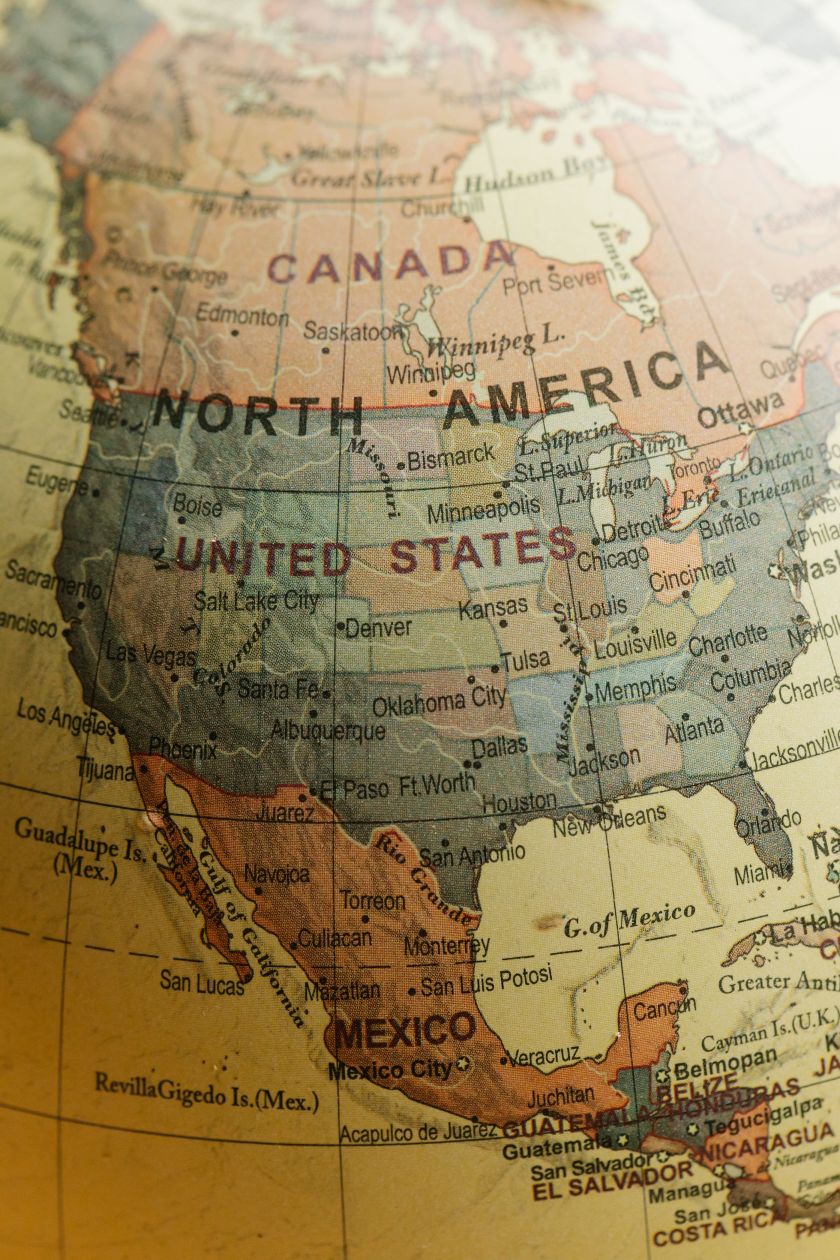
Most Canadians reside not far from the US border. 90 percent of Canadians live within 100 miles (160 km) of the border and this is mostly due to climate, settlement patterns, transportation, etc.
How many US states border Canada?
There are a total of 13 states that border Canada: Maine, New Hampshire, Vermont, New York, Pennsylvania, Ohio, Michigan, Minnesota, North Dakota, Montana, Idaho, Washington, and Alaska. Canada is a country located to the north of the United States. The US border with Canada has been changed a number of times in American history.
The Canada-United States border is the longest international border in the world at 5,525 miles and with more than 100 crossings. Not all of the border crossings are open 24 hours a day, 7 days a week, year-round. People can cross them by land, ferry, and international airports.
Who can cross the Canada-US border?
People who are allowed to cross the Canada-US border are either citizens of the United States or people who have a visa that allows them to stay in the United States for an extended period of time. Citizens of the United States must have a passport or other document that proves their citizenship. People who have a visa that allows them to stay in the United States for an extended period of time must have a valid visa, passport, or another document that proves they can stay in the United States.
What ID is needed to cross the US border from Canada?
Depending on whether you’re traveling by land, air, rail, or boat to cross the border with Canada, different kinds of documents are needed.
For American Citizens
American citizens who are arriving by land or sea are required to produce one of the documents below to enter the country.
Passport
United States Passport Card
Trusted Traveler Cards – NEXUS, SENTRI, or FAST
Global Entry Card
Enhanced Driver’s License or Enhanced
Identification Card – EDL / EIC
Military ID or Merchant Marine Document
Must be traveling on official orders or maritime business, respectively
Family members over 15 years old must still present passports
Enhanced Tribal Card
Children under 15 may present a passport as well, but there are also the following options:
Birth certificate (original copy)
Consular Report of Birth Abroad
Naturalization Certificate
These rules also apply to children aged 16-18 if they are traveling with a group (school group, sports team, etc.).
Closed-loop cruises (which begin and end at the same U.S. port)
You can re-enter the US with only a birth certificate and government-issued photo I.D. But remember to still bring your passport with you in case your cruise visits other countries.
American citizens arriving by air must present one of the following documents to enter the country:
Passport
A passport card is not allowed.
Children must have their own passports as well
Check that it’s not expired!
NEXUS card
Merchant mariner card or U.S. military identification card
Accepted only if you are traveling on official business
Non-citizens entering the United States
If you’re a citizen of another country entering the US, you will need one of the documents below.
Valid Passport
The United States often requires visitors from certain nations, including Canada, to submit passports that are current at the time of border crossing and valid for up to six months after the date of their intended departure date.
You’ll probably be subject to a second inspection if your passport has expired. The border agent will have the last say regarding your admission to the United States.
Lawful permanent residents must provide their Lawful Permanent Resident Card (Form I-551) or another acceptable form of identification as verification of their status as lawful permanent residents.
Children who are Canadian citizens and are under 16 years old may utilize a birth certificate or other documentation of citizenship. The birth certificate is available as an original, certified copy, or photocopy.
As long as they’re traveling with a group, it also applies to kids under 19 (school trip, sports team, etc.).
You may need to get a visa depending on your country of origin and your reason for traveling. Visitors from Canada and Bermuda, in addition to visitors from the 39 countries in the Visa Waiver Program, do not require visas.
Requirements to cross the United States-Canadian border by car:
Driver’s license: The driver of the car must have a valid license.
Vehicle registration: Border officials are often on the lookout for stolen vehicles, or people trying to avoid duties on vehicles purchased out of the country.
Proof of insurance: It’s recommended that you bring your vehicle’s insurance paperwork.
What is the wait time at the US-Canada border?
The wait times can range from no delays up to 20 minutes, specifically on both the commercial and traveler flows at Sweetgrass–Coutts Border Crossing in Montana. Updates on wait times can be researched online.
The Ambassador Bridge connects is the busiest international border crossing in North America based on trade volume.
How long is the southern US-Canada border?
The southern US-Canada border measures 8,891 km (5,525 mi) long. Meanwhile, Alaska shares the longest border with Canada of any state. The 1,538-miles (2,475 km) long border is shared with Yukon and British Columbia.
What established the border between the US and Canada?
The Oregon Treaty was signed by representatives of Great Britain and the United States, and it resolved a long-running disagreement with Britain over who has authority of the Oregon area. The 49th parallel, which runs from the Rocky Mountains to the Strait of Georgia, was designated as the border between the US and British Canada by the treaty. With this, the British retained control of Vancouver Island and the right of navigation along a portion of the Columbia River, while the US officially took authority of the future states of Oregon, Washington, Idaho, and Montana.
What large lake system is located on the border of the US and Canada?
The series of deep freshwater lakes known as the Great Lakes includes the Lakes Superior, Michigan, Huron, Erie, and Ontario and is situated in east-central North America. Except for Lake Michigan, the lakes serve as a natural border between Canada and the United States, a frontier that was established by a boundary-waters treaty of 1909. It is a source of pride and understanding for both countries that there are no fortifications or warships along the boundary.
The relationship between Canada and the United States is a dynamic one, characterized by geographical proximity, cultural similarities, and extensive economic ties. A striking fact that reinforces this connection is that about 90 percent of Canadians reside within 100 miles (160 kilometers) of the US border. This fascinating statistic can be attributed to a combination of factors such as climate, settlement patterns, and transportation considerations.
In terms of geographical connectivity, 13 US states share a border with Canada. These states include Maine, New Hampshire, Vermont, New York, Pennsylvania, Ohio, Michigan, Minnesota, North Dakota, Montana, Idaho, Washington, and Alaska. The border between these two nations is the longest international boundary globally, measuring an impressive 5,525 miles. This border houses more than 100 crossings, though it’s worth noting that not all of these are open 24/7 throughout the year. One can cross these points by land, ferry, or at international airports.
The question of who can cross the Canada-US border is an important one. Essentially, individuals permitted to cross are either United States citizens or individuals holding a visa allowing them an extended stay in the US. In both cases, proper identification, such as a passport or valid visa, is required.
The type of identification required to cross the US border from Canada can vary depending on the mode of transportation. American citizens arriving by land or sea may use a variety of documents including a passport, United States Passport Card, Trusted Traveler Cards (NEXUS, SENTRI, or FAST), Global Entry Card, Enhanced Driver’s License, or Enhanced Identification Card. Children under 15 have additional options like presenting a birth certificate, Consular Report of Birth Abroad, or Naturalization Certificate. On the other hand, non-citizens entering the United States will need a valid passport, and depending on their country of origin, possibly a visa.
The US-Canada border crossing experience can be different based on various factors, one of which includes the wait time. This can range from no delay to upwards of 20 minutes, particularly at the bustling Sweetgrass–Coutts Border Crossing in Montana. The Ambassador Bridge, in particular, is recognized as the busiest international border crossing in North America, owing to its immense trade volume.
The establishment of the border between the US and Canada was a significant historical event. The boundary was determined by the Oregon Treaty, signed by representatives from Great Britain and the United States. The treaty set the 49th parallel as the border from the Rocky Mountains to the Strait of Georgia.
Finally, a geographical feature that symbolizes the US-Canada border’s unique character is the Great Lakes system. These bodies of water, excluding Lake Michigan, form a natural boundary between the two countries, marking a peaceful frontier devoid of fortifications or warships, reflecting mutual respect and understanding.
In conclusion, the close proximity of Canadians to the US border is a testament to the shared history, geography, and cultural ties that bind these two nations together. Whether it’s crossing the border for travel, trade, or tourism, this relationship remains an integral part of North American life.


 My Web Stats